Shree Dwarkadhish Temple: Timings, History & How to Reach

Jay Dwarkadhish! Shree Dwarkadhish Temple is dedicated to Lord Krishna, the 8th incarnation of Lord Vishnu. Dwarkadhish Temple, also known as Jagat Mandir, is a Chalukya-style architecture dedicated to Lord Krishna. The history of the city of Dwarka dates back to the time of the Dwaraka Kingdom in the Mahabharata.

Shree Dwarkadhish temple is located in Dwarka, Gujrat state. Dwarka is an ancient city in India, located at the western tip of the Saurashtra peninsula in Gujarat. Known as Devbhoomi, Dwarka is the only city in the Char Dham (four major holy places) and Sapta Puri (seven sacred cities) described in Hinduism.

Shree Dwarkadhish Temple

In today’s article, we will cover all the aspects of Shree Dwarkadhish Temple, such as its history, unknown facts about the temple, timing, dress code, and much more. Let us dive into the journey of uncovering such amazing temples with 99Pandit.

99Pandit is an official website for puja and Pandit services where you can perform any puja, havan, and Jaap with Pandit’s help, which you can book from 99Pandit.

What is Shree Dwarkadhish Temple?

Dwarka is a major Hindu pilgrimage site located in Devbhoomi Dwarka district of Gujarat, which is the second Dham among the Char Dhams. Shree Dwarkadhish Temple is the main temple of Dwarka which is also known as Jagat Mandir or Brahmanda Mandir.

Shree Dwarkadhish temple is one of the important temples in Gujarat, and it is also called the Jagat Mandir. Here, Lord Krishna is worshipped as Dwarkadhish, also known as the “King of Dwarka.” This is also known as one of the destinations of Char Dham in a Hindu pilgrimage group.
99pandit

100% FREE CALL TO DECIDE DATE(MUHURAT)

99pandit

Thousands of people visited this temple throughout the year. Here, we have provided complete information on Dwarkadhis Temple Timings. You should go through these details before visiting the temple. On the day of Janmashtami, the Lord is given an open bath in the temple, and common people can also see his bath and makeup.

Timings of Shree Dwarkadhish Temple

Dwarkadhish Temple Morning Darshan Timetable

Darshan Timings
Mangla Aarti 6:00 AM
Mangla Darshan 7:00 AM to 8:00 AM
Abhishek Pooja [Snan Vidhi]: Darshan Closed 8:00 AM to 9:00 AM
Shringar Darshan 9:00 AM to 9:30 AM
Snanbhog: Darshan Closed 9:30 AM to 9:45 AM
Shringar Darshan 9:45 AM to 10:15 AM
Shringarbhog: Darshan Closed 10:15 AM to 10:30 AM
Shringar Aarti 10:30 AM to 10:45 AM
Gwal Bhog: Darshan Closed 11:05 AM to 11:20 AM
Open For Darshan 11:20 AM to 12:00 Afternoon
Rajbhog: Darshan Closed 12:00 Afternoon to 12:20 PM
Open For Darshan 12:20 PM to 12:30 PM
Anosar, Darshan Closed 1:00 PM


Dwarkadhis Temple Evening Darshan Timetable

Darshan Timings
First Darshan 5:00 PM
Uthappam Bhog: Darshan Closed 5:30 PM to 5:45 PM
Open For Darshan 5:45 PM to 7:15 PM
Sandhya Bhog: Darshan Closed 7:15 PM to 7:30 PM
Sandhya Aarti 7:30 PM to 7:45 PM
Shayanbhog: Darshan Closed 8:00 PM to 8:10 PM
Open For Darshan 8:10 PM to 8:30 PM
Shayan Aarti 8:30 PM to 8:35 PM
Open For Darshan 8:35 PM to 9:00 PM
Bantabhog and Shayan: Darshan Closed 9:00 PM to 9:20 PM
Open For Darshan 9:20 PM to 9:30 PM
Mandir Closed 9:30 PM


Dwarkadhish Temple Timings

Temple Darshan Timings Time
Morning 6:30 AM to 1:00 PM
Evening 5:00 PM to 9:30 PM


Shree Dwarkadhish Temple Aarti Timings

Aarti Timings Time
Mangla Aarti 6:00 AM
Shringar Aarti 10:30 AM to 10:45 AM
Sandhya Aarti 7:30 PM to 7:45 PM
Shayan Aarti 8:30 PM to 8:35 PM


Dwarkadhish Temple Bhog Timings

Bhog Timings Time
Snanbhog Morning 9:30 AM to 9:45 AM
Shringarbhog Morning 10:15 AM to 10:30 AM
Gwal Bhog Morning 11:05 AM to 11:20 AM
Rajbhog Afternoon 12:00 PM to 12:20 PM
Uthappam Bhog Evening 5:30 PM to 5:45 PM
Sandhya Bhog Night 8:00 PM to 8:10 PM
Banta Bhog Night 9:00 PM to 9:20 PM


Abhishek Timings at Dwarkadhish Temple

Abhishek Pooja (Snan Vidhi): 8:00 AM to 9:00 AM

What is the Significance of Tula Daan in Shree Dwarkadhish Temple?

Once, Satyabhama donated Dwarkadhish to Narad Muni. Realizing her mistake, when she asked for Dwarkadhish back, Narad said that you would have to put money equal to Krishna’s weight on the scale.

All the money of Dwarka was put on the scale but Krishna did not budge. Rukmani came and completed this Tula Daan by putting a tulsi (basil) leaf. This Tula Daan is done by special Pandits. In short, by making this donation, long life, success, name, and power.

Shree Dwarkadhish Temple

You can effortlessly find and book Pandit for Tula Daan from 99Pandit. Pandit will help you throughout the puja with Vedic mantras and rituals.

History of Shree Dwarkadhish Temple

There are many grand and beautiful temples of Shri Krishna in India. Devotees have deep faith in them. But Shree Dwarkadhish Temple or Jagat Mandir of Dwarka is considered to be the oldest among them.

It is said that this temple is more than 2 thousand years old, and its history is also very interesting. According to the belief, this temple was first built by Shri Krishna’s great-grandson Vajranabh. But in the 16th century, the temple got its present form.

It is one of the 4 Dhams of the country established by Adi Shankaracharya. It is estimated that Shree Dwarkadhish temple here is 2500 years old. Dwarka is called the city of Shri Krishna. Because when Shri Krishna left Mathura, he came here and established his city. In which he also built a palace named ‘Hari Griha’ for himself.

99pandit

100% FREE CALL TO DECIDE DATE(MUHURAT)

99pandit

This palace is known as Jagat Mandir today. Apart from this, the temple is also known as Dwarkadhish Temple. This five-story temple is built on 72 pillars. There are two gates in the temple.

The one in the north direction is called Moksha Dwar, while the one in the south direction is called Swarg Dwar. On the east side of the temple is the temple of Durvasa Rishi, and on the south side is the Sharda Math of Jagadguru Shankaracharya.

It is said that after taking a bath in the lake of Uttarakhand, Shri Krishna changes his clothes in Dwarka, then eats food in Odisha Jagannath Puri and rests in Rameswaram Dham. During this time, he comes among the devotees.

Amazing Facts about Shree Dwarkadhish Temple

There are the following amazing and unknown facts about the Shree Dwarkadhish Temple:

  • In the Shree Dwarkadhish temple of Gujarat, two flags are installed, called Raksha flags, and it is believed that this flag protects the temple. 
  • You will be surprised to know that the flag on this temple is changed 5 times a day.
  • The flag is 52 yards which is formed by combining 52 numbers, 12 zodiac signs, 27 constellations, 10 directions, Sun, Moon, and Shri Dwarkadhish.
  • Apart from this, it is also accepted that at one time, there were 52 gates in this temple.
  • According to mythology, after the death of Lord Krishna, the city of Dwarka drowned in the sea.
  • There are two gates to enter Dwarkadhish temple. The door on the north side is called Moksha Dwar, and the door on the south side is called Swarga Dwar.
  • The dark-coloured, four-armed statue of Lord Krishna sits on a silver throne in the sanctum sanctorum of the Dwarkadhish temple.
  • According to mythology, Dwarkadhish Dham is considered to be the most beautiful of the three worlds that is Swarg Lok, Bhu Lok, and Pataal Lok.
  •  It is one of the seven puris (seven holy cities) of Hindus; hence, this district has been named Dwarkapuri. 
  • The main temple of Dwarkadhish Temple is about 2500 years old and was built by Vajranabha, the great-grandson of Lord Krishna.
  • According to the scriptures, the city of Dwarka was settled by Lord Krishna, and after the Mahabharata war, this city completely merged into the sea, after which this temple was built.

Dress Code for Shree Dwarkadhish Temple

Whenever you go to any religious place, you should wear such clothes which are decent and comfortable to wear. When you bow your head in front of God in the temple, there is no problem if you wear decent and comfortable clothes.

For vising Shree Dwarkadhish Temple following dress code should be followed:

Dress Code for Men: According to the Shree Dwarkadhish Temple Committee, men can come to the temple wearing shirts, trousers, dhoti, and pajamas with upper plackets.

Dress Code for Women: For women, apart from sarees, half sarees, blouses, churidar pajamas, and upper clothes are included in the dress code. Shorts, mini skirts, midis, sleeveless tops, low-waist jeans, and short-length t-shirts are prohibited.

How to Reach Shree Dwarkadhish Temple?

Shree Dwarkadhish Temple, located in Dwarka, Gujarat, is one of the 4 Dhams of the country, also known as Dwarka Nagari. It is acknowledged by the locals that it was founded by Adi Shankaracharya. This temple is about 2,000 to 2200 years old. The building of this temple is 5 stories, and its height is 235 meters.

Shree Dwarkadhish Temple

This building rests on 72 pillars. It is believed that the Dwarkadhish temple was built by Vajrabha, the grandson of Lord Shri Krishna. There are the following ways through which you can reach Dwarka to visit the temple:

By Air

There is no direct flight to reach Dwarka. The nearest airport to Dwarka is Jamnagar, which is 47 km away. Apart from this, you can also take a flight to Porbandar Airport. This airport is about 98 km from Dwarka.

You can take a car from the airport, which will take you directly to Shree Dwarkadhish Temple. You will easily get flights from major cities of the country for both airports.

By Train

Dwarka is connected to many cities in the country through a rail network. You will get many trains daily to Dwarka Railway Station. Once you reach Dwarka station, it is easy for you to reach the temple, as the distance between the station and the temple is just 2.5 kilometers. Dwarka’s rail is connected to many major parts of the country.

By Road

Dwarka is connected to almost all the major cities of the country by road. You can not only reach there by your vehicle but you will also get many bus services to reach the temple, which you can choose according to your convenience.

Places to Visit near Shree Dwarkadhish Temple

Badkeshwar Mahadev Temple

Badkeshwar Mahadev Temple is a very ancient temple situated on the seashore. This temple is located at a distance of 2 km from Shree Dwarkadhish Temple. The waves of the sea are always seen touching the temple premises. This temple submerges in the sea during the monsoon season.

Nageshwar Jyotirlinga Temple

Nageshwar Jyotirlinga Temple in Dwarka is one of the 12 Jyotirlingas of India. The temple has a huge 80 feet statue of Lord Shiva in a sitting posture. This temple is located at a distance of 16 km from Dwarkadhish Temple. Shiva devotees come in large numbers to visit and ask for their wishes after seeing Lord Shiva.

Rukmani Mata Temple

Rukmini Mata Temple is situated away from Dwarkadhish Temple. Rukmini Devi Temple is dedicated to the first wife of Lord Krishna. This temple is situated at a distance of 3 km from Dwarka Nagar.

According to mythology, it is said that when Durvasa Rishi cursed, Rukmani Devi would stay away from Lord Shri Krishna. Due to the curse given by the sage, even today, Rukmani Mata Temple is situated away from the Dwarka Nagar boundary.

Bet Dwarka

Bet Dwarka is a beautiful island situated on the sea. This place is 30 km away from the Shree Dwarkadhish temple. To reach Bet Dwarka, one has to travel by boat. Bet Dwarka has a very deep mythological significance.

99pandit

100% FREE CALL TO DECIDE DATE(MUHURAT)

99pandit

It is said that when Lord Krishna’s best friend Sudama ji went to meet Krishna, Lord Krishna and Sudama met for the first time at this place. That is why this place is called Bet Dwarka.

Gopi Talav

Gopi Talav is the most beautiful pilgrimage place in Dwarka. This lake is situated around 20 km from the city of Dwarka on the way to Bet Dwarka. According to mythology, it is said that Lord Shri Krishna used to bathe in this pond. And it was in Gopi Talav that he performed Raasleela with the opis.

It is said that due to being away from Lord Shri Krishna, the Gopis, after bathing for the last time, merged into the soil in the pond, and even today, devotees take the soil of the pond as Gopi Chandan.

Conclusion

Shree Dwarkadhish Temple in Dwarka Gujrat is one of the most important Hindu temples. The pilgrims visit the Shree Dwarkadhish Temple to seek blessings of Lord Krishna, the 8th incarnation of Lord Vishnu.

In the holy place Dwarkadham, along with Shree Dwarkadhish temple, there are several other religious places such as Rukmini Mata Mandir, Bet Dwarka, Sudama Setu, Badkeshwar Mahadev Temple, Gopi Talav, Nageshwar Jyotirling, etc to visit and they also have religious significance.

Today, through this article, we have learned so much about Shree Dwarkadhish Temple. I hope you find this article helpful and like it. Apart from this, if you wish to Book a Pandit, then you can visit our website, which is 99Pandit for Griha Pravesh Puja, Maha Mrityunjaya Jaap, different homams, and much more. Booking a pandit now becomes effortless and hassle-free.

Kamakhya Devi Temple in Assam: Timings, History & How to Reach

Kamakhya Devi Temple in Assam is dedicated to Goddess Shakti. It is a famous shrine found in the heart of Nilachala Hill, situated in the western part of Guwahati, the Capital City of the state of Assam in North East India. It is the centrepiece of the widely practised, powerful Tantrik Shaktism cult in India.

People come to visit Kamakhya Devi Temple in Assam from far and wide to receive the blessings of the Mother. As per beliefs, the part of the vagina of the Maa Sati fell here.

Kamakhya Devi Temple in Assam

This temple is located at a distance of about 8 kilometres from Guwahati in Assam. Each year a magnificent Ambubachi fair is organized here. Many devotees, saints, and tantriks come from far and wide to attend this fair.

During this time, the water of the nearby Brahmaputra river turns red for three days. It is said that this red colour of the water is due to Kamakhya Devi’s menstruation. After three days, a crowd of devotees flocks to the temple for darshan.

The Ambubachi fair is held here every year in the month of Ashadh. In this article, we learn more about the importance, history, and mythological stories of Kamakhya Devi Temple.

What is Kamakhya Devi Temple in Assam?

Kamakhya Devi temple is located just 13 kilometres away from Dispur, the capital of Assam state. It is located on the Kamagiri mountain (Neechalach mountain) located in Guwahati city of Kamrup district of Assam.

Kamakhya Devi Temple is one of the 52 Shaktipeeths. It is believed that the vagina part of Goddess Sati fell here. Therefore, the vagina form of the mother is worshipped here. This Shaktipeeth is considered to be a major place of Tantra Sadhana.

99pandit

100% FREE CALL TO DECIDE DATE(MUHURAT)

99pandit

Maa Kamakhya, or Kameswari, is the renowned Goddess of Desire. Maa Kamakhya Devalaya is considered the most sacred and oldest of the 52 Shakti Peethas on earth.

Along with the main temple of Devi Kamakhya, there are temples of the Dasamahavidya (ten incarnations of the deity) namely Kamakhya (i.e. Tripura Sundari, along with Matangi and Kamala), Tara, Kali, Bagalamukhi, Bhuvaneshvari, Bhairavi, Dhumavati, Chinnamasta, and five temples of Lord Shiva namely Siddheswara, Kameswara, Amratokeswara, Kedareswara, Aghora and Kautilinga around the Nilachala Hill which is also named as Complex of Kamakhya Temple.

Kamakhya Devi Temple in Assam: Timings

Morning Activities

  • 5:30 AM – Back bath.
  • 6:00 AM – Daily puja.
  • 8:00 AM – Temple door opens for devotees to have darshan.

Evening Activities

  • 1:00 PM – The temple door is closed to prepare the Prasad of the Goddess.
  • 2:30 PM – The temple door is reopened for devotees, and Prasad is distributed.
  • 5:15 pm – Temple doors are closed for the night.
  • 7:30 pm – Aarti of Goddess Kamakhya is performed.

Special Activities

  • 5:30 AM – Back bath
  • 6:00 AM – Nitya Puja and Sharadiya Durga Puja.
  • 9:00 AM – Temple doors are opened for devotees.
  • 1:00 PM – The temple door is closed to prepare the goddess’ Prasad. After sunset, the temple door is closed.
  • 7:30 pm – Aarti of Goddess Kamakhya.

Kamakhya Devi Temple in Assam: History

The Kamakhya Temple is one of the oldest temples in India and naturally, has centuries of history attached to it. It is believed to have been built between the eighth and ninth centuries, or rather during the Mleccha dynasty.

When Hussein Shah invaded the Kamakhya kingdom, he demolished the Kamakhya temple, leaving nothing to be found, and the temple fell into ruins. This remained so until it was rediscovered in the 1500s, when Vishwasingh, the founder of the Koch dynasty, revived the temple as a place of worship.

Kamakhya Devi Temple in Assam

After this, when his son took over the throne, he rebuilt this temple in 1565. Since then, this temple is the same as it appears today. The history of this temple is still hidden behind its walls.

Pilgrims from different parts of the country come here for darshan. Thousands of people come here every year to see the goddess. Kamakhya temple is the biggest attraction for any tourist coming to Guwahati.

Mythological Stories about Kamakhya Devi Temple

Kamakhya Devi Temple in Assam is one of the 52 Shakti Peethas of the Goddess Shakti and is situated on Nilachal Mountain in Assam. This Shakti Peeth is considered the best for Tantric practices. Let us know the Mythological stories about Kamakhya Devi Temple.

Establishment of the Temple

As per the mythology, when Goddess Sati sacrificed her life in the Yagya, Lord Shiva wandered the entire world with the burnt body of Mata Sati, due to which his rage kept rising.

Then to control the trouble, Shri Hari (Lord Vishnu) started cutting the body parts of Mata Sati with his Sudarshan Chakra, and 52 Shaktipeeths were established at the 52 locations on earth where the body parts of Devi Sati fell.

It is believed that the vagina of the mother fell on Nilanchal mountain, due to which Kamakhya Devi Shaktipeeth was established here. It is believed that the vagina of the mother fell and transformed into an idol, which is still present in the temple and due to which the idol of the mother menstruates even today.

The Idol of the Goddess Menstruates

Every year when the Goddess menstruates, the Ambubachi fair is organized here. During those days, the doors of the Goddess Bhagwati temple automatically close, this goes on for three days. During those three days, no auspicious work is done in Guwahati, nor does any temple open.

99pandit

100% FREE CALL TO DECIDE DATE(MUHURAT)

99pandit

After this, on the fourth day, the idol of Kamakhya Devi is bathed, Vedic rituals are performed, etc., and the temple is reopened for people to visit. This temple is unique in itself. Such a miracle and a method of worship is not seen anywhere else in the world.

Unique Prasad

A unique Prasad is given to the devotees during the Ambubachi fair, which is a red-coloured wet cloth. It is said that before the goddess menstruates, a dry white cloth is spread around the idol of Mata Kamakhya, but after three days when the doors are opened, this cloth becomes blood red due to the goddess’s menstrual blood and this divine prasad cloth is called Ambubachi cloth. It is believed that one can easily attain Siddhi by wearing this cloth and worshipping Shakti.

The River Brahmaputra also turns Red

Every year during this fair, the water of the nearby Brahmaputra river also turns red, which symbolizes the menstruation of Kamakhya Devi. Bathing in this river is also considered taboo during these days.

Unknown Facts about Kamakhya Devi Temple

1. You will not see any picture of the Goddess in this temple. Rather, there is a pond here, which is covered with flowers, from where water always flows. It is believed that the vagina of the Goddess is worshipped in this temple. And due to being a vagina, the Goddess also menstruates here.

2. According to the Puranas, it is believed that to break Lord Shiva’s attachment towards Sati, Lord Vishnu broke Sati into 52 pieces with his Chakra. After which, wherever these pieces fell, a Shakti Peeth was formed there.

3. This place holds a lot of importance for tantriks or those who practice black magic. Apart from this, people come here from far away places to fulfil many wishes related to their lives.

4. The Ambubachi fair is held here, during which the water of Brahmaputra turns red for three days. It is believed that this happens due to Kamakhya Devi’s menstruation. It is believed that the goddess menstruates for three days, during which the temple of the goddess remains closed. After three days, the temple of the goddess is opened again with great pomp and show, and a crowd of devotees gathers.

5. A very unique prasad is given here. A white cloth is kept in the court of the mother for three days due to menstruation. After three days, when the court opens, the cloth is soaked in red colour due to menstrual blood, which is given to the devotees as prasad.

How to reach Kamakhya Devi Temple in Assam

Kamakhya Devi temple in Assam is located just 13 kilometres away from Dispur, the capital of the state. This Shaktipeeth is considered to be a major place of Tantra Sadhana. Every year more than lakhs of Pilgrims come here for darshan.

Kamakhya Devi Temple in Assam

There are many ways to reach Kamakhya temple, including by air, train, and road.

By Air Transport

The nearest popular Gopinath Bardoloi Airport (Guwahati International Airport) to Kamakhya temple is. The distance of the temple from the airport is just 20 kilometres. Regular flights are available for this airport from New Delhi, Mumbai and Chennai. You can come here and go to the temple by taxi, auto or bus.

By Train

Kamakhya City has its junction. Its name is Kamakhya Junction Railway Station. However, Guwahati Railway Station is the best for connectivity to all corners of the country. After reaching Guwahati Railway Station, one can travel to the temple or your decided hotel by taking an auto/bus.

By Road

There is a distance of 8 km between Guwahati Railway Station and Kamakhya Temple. Exit the railway station and cross the foot over the bridge. Like other goddess temples, Kamakhya Devi Temple is also situated on a hill.

The name of this hill is Nilachal Parvat. Stairs start from the bottom of this hill, where you can start the journey to the temple. There is also a provision of porters for older people.

Precautions to take when visiting Kamakhya Devi Temple

Some special precautions should be taken during Ambuvachi in Kamakhya temple.

  • One should not bathe in the river at the time of Ambuvachi Mela. 
  • One should not dig the ground or soil and neither should any seeds be sown. 
  • Conch and bell are not played here during these days.
  • Devotees abstain from eating food and fruits and vegetables grown under the ground. 
  • It is very important to follow celibacy. 
  • One should chant the mantras of one’s Ishtadev as much as possible.

Conclusion

It is said that the places where the body parts of Mata Sati fell are called Shaktipeeth. There are many such Shaktipeeths in India, where Mata Sati is worshipped. One of these Shaktipeeths is Kamakhya Devi Temple in Assam, whose famous shrine is located in the heart of Nilachala Hill, situated in the western part of Guwahati.

It is the centrepiece of the widely practised, powerful Tantrik Shaktism cult in India. This temple is built in the shape of a boat, which is divided into three chambers. Many people seeking liberation from the bondage of birth and death have received the blessings of the Goddess Mother in this ancient temple.

If someone has been subjected to black magic, he can come here and get rid of this problem. The Tantrik and Sadhu of Kamakhya are experts in performing miracles.
Many people go on pilgrimage to Kamakhya to fulfil their wishes of marriage, children, wealth, and other desires. It is said that the tantriks here are also capable of driving away evil forces.

Mata Vaishno Devi Temple: Timings, History, & Temple Rituals

Mata Vaishno Devi Temple: Are you also Planning to visit one of the most religious holy places in Hinduism Mata Vaishno Devi Temple? You need to keep a few things in mind before visiting this Temple. Mata Vaishno Devi Temple is one of the most divine pilgrimage regions in Northern India.

It is one of the widely toured Hindu temples dedicated to Mata Vaishno Devi. It is located in Katra, in the Trikuta Mountains within the state of Jammu and Kashmir. Devotees from every corner of the world visit this holy place to show their devotion to the goddess and seek blessings.

Mata Vaishno Devi Temple

According to Hindu tradition, it is believed that whosoever is blessed by the goddess will get whatever they desire. The Prilgrim’s journey from the base town of Katra to the holy cave is approximately thirteen kilometres, which is much more than just a physical challenge.

Chanting “Jai Mata DI” with each step shows the testament of millions of devotees and their faith and devotion towards the Goddess. Read this complete blog post to find out some interesting facts about this “Aishwarya” temple dedicated to Mata Vaishno Devi.

Mata Vaishno Devi :The Divine Enchantress

Mata Vaishno Devi is a powerful manifestation of divine femininity that combines the energies of Goddess Makhali, the ferocious protector; Mahalakshmi, the goddess of wealth and fortune; and Mahasaraswati; the goddess of learning.

The goddess resides inside the holy cave in the three natural rock forms known as “Pindis” which signifies the goddess in three different forms holding religious importance among pilgrims. There are no other statues or idols of gods inside the cave.

It is believed that the skull of Mata Sati fell at this place which is one of the reasons that this place is considered one of the most important Shaktipeeth. The origin of Mata Vaishno Devi is deeply rooted in the Hindu scriptures. According to Hindu Mythology, it is believed that a goddess was born in the southern part of India as a young girl named Vaishnavi.

99pandit

100% FREE CALL TO DECIDE DATE(MUHURAT)

99pandit

From a young age, she has been a sincere devotee of lord Vishnu and displayed an uncompromising devotion to her faith. She was born to a sage named Ratnakar Sagar, who has been childless for several years. Brought up in the spirit of devotion to Lord Vishnu, her devotion to him intensified, and she expressed her desire to get married to him.

At the time of Ramayana when Lord Rama is searching for his wife Mata Sita comes across Vaishnavi, where she vowed to get married to him. Lord Rama being Ekpatnivarta cannot marry any other woman.

Impressed by her devotion, he promised her that he would marry her in the last reincarnation in Kaliyug in the avatar of Kalki. Hence, Lord Rama asked her to meditate in the cave of the Trikuta Mountains which is now known as the Mata Vaishno Devi.

History of Mata Vaishno Devi Temple

Many legends surround the temple and many believe that the temple is a manifestation of the Hindu Goddess. The historical significance behind the Mata Vaishno Devi Temple is still unfolded and shrouded in Hindu mythology and legends.

It is difficult to mention when exactly the pilgrimage at this holy shrine started. Based on Hindu scriptures it is believed that the holy cave is almost around a million years old.

Mata Vaishno Devi Temple

As per Hindu scriptures, it is said that Pandavas were the first ones who built the Temple at Kol Kandoli and Bhawan to pay gratitude to the Goddess. Watching the holy cave you will notice five stone structures, which are believed to be rock symbols of the five Pandavas.

The first mention of this holy cave is been in seen in the epic Mahabharat. When the Battle was ongoing between the Pandavas and Kurukshetra, on the advice of Krishna, Arjuna prayed to seek the blessing for victory.

That’s when Arjuna addresses the Mother Goddess as ‘Jambookatak Chityaishu Nityam Sannihitalaye’, which means ‘you who always dwell in the temple on the slope of the mountain in Jamboo’ (Jamboo here refers to present-day Jammu).

The cave was discovered by a Hindu Priest named Pandit Sridhar who saw the mother Goddess in his dream and guided him to find the temple. Impressed by him for finding a temple, the Mata Vaishno Devi appeared and blessed him with four sons. Also, made him the custodian of the holy cave, and his role has continued with passing generations even today.

Timings of Mata Vaishno Devi Temple

Mata Vaishno Devi Temple welcomes its devotees for pilgrimage throughout the year. Lakhs of devotees visit this holy place every year, specifically at the time of festivals or any special days the pilgrimage season seems to surge.

Devotees can seek blessings on any weekday from 5:00 am to noon, after which the Temple is temporarily closed it is believed it is timing for the Goddess to have some rest. It reopens again from 4:00 pm to 9:00 pm giving devotees another opportunity to seek the blessing of the Goddess.

The General Timings of Temple are as follows:

  • Morning Aarti: Gates of the temple open early in the morning, allowing the devotees to observe morning aarti. Generally, the timing of morning aarti is around 6:00 am to 8:00 am. The flames of aarti light in front of Mother Goddess and the temple fills with devotees’ hymns and chants.
  • Daytime Aarti: 1:00 pm to 2:00 pm day time Aarti is performed which is also called Bhog Aarti. During this Aarti Bhog is offered in front of the Goddess idol and after that distributed in the form of prasad to devotees.
  • Evening Aarti: As the day comes to close to draws, the evening aarti is the last Aarti offered to Mata Vaishno Devi. The timing of evening aarti is from 7:00 pm to 8:00 pm when the temple glows up in the light of lamp and diyas.
  • Night-Time Darshan: The Temple is open for night darshan on certain days for the devotees to gain a unique and magical experience. Visiting the temple at Night is another experience the mountains are covered in darkness through which the divine Temple peeks with dazzling lights.

Rituals Inside Mata Vaishno Devi Temple

Aatam Puja

Before the Aarti is performed, there is a ritual called “Aatam Puja’’ where the Vaishno Devi is bathed in milk, water, sugar, dahi, and honey. Pujaris chant shlokas and mantras during the process when the Goddess is adorned in saree, Chola, chuni, and ornaments. Thereafter, tilak is placed at the forehead of the divine Goddess and pujaris perform puja after this process.

Aarti

Aarti is the most important ceremony that is performed in Mata Vaishno Devi Temple. Vaishno Mata Aarti is performed twice or thrice a day, aarti performed in the morning is known as ‘“Mangal Aarti”, and one performed in the evening is known as “Sandhya aarti”.

The Diya or Joyti is lightened up to perform the Aarti in front of the idol. At Mata Vaishno Devi Temple Aarti is offered in two places firstly in front of the Mother Goddess and secondly outside the holy cave. Devotees assemble in the front of the temple to seek blessings from the divine Goddess.

Parsad Offering

In Hindu temples offering a prasad to God or Goddess has its significance. After performing various rituals and aarti, different types of food items like fruits and sweets are offered to Mata Vaishno Devi.

It is considered that the deity partakes of and then returns the offering which is then called Parasd. Later the Priest offers the Parsad to devotess as a blessing of Goddess.

Charan Paduka Darshan

At Mata Vaishno Devi Temple another ritual that is performed is Charan Paduka Darshan. It is the footprints of Mata Vaishno Devi that is situated at a distance of 1.5 Kilometers from the main temple.

It is said that this white temple where Charan Paduka is placed is believed to be the place where Mata Vaishno Devi stopped over to check if she was still being chased by Bhairon Nath.

99pandit

100% FREE CALL TO DECIDE DATE(MUHURAT)

99pandit

To see if Bhairav Nath was still chasing her or not, she stood on the rock to see him since the rock supposedly contained her footprints. Several Devotees visit this temple to pray and pay gratitude to the Goddess’s footprints.

Havan

Havan or yagna is the fire ritual that is performed every morning at Yagyshalla inside the Mata Vaishno Devi Temple. The temple priest performs Hawan by offering ghee, herbs, and sacred items into the fire while chanting mantras. Performing Havan creates the energy that not only purifies but also brings peace and harmony to the surroundings.

How to Reach Mata Vaishno Devi Temple?

Before Visiting the Mata Vaishno Devi Temple it is important to know how to reach. Reaching the temple is not as much as difficult as it used to be because of the various modes of transport that are available today.

Mata Vaishno Devi Temple

Here is some detailed information about reaching Mata Vaishno Devi temple by various modes of transport.

By Air

The Closest Airport from Katra is Jammu Airport also known as Satwari Airport. It is located almost 50 km from Katra and has well-connected flights from other cities in India. It is one fastest ways to reach Katra from any city in India. Devotees can take a taxi from the airport to Katra once they reach Jammu airport.

Helicopter services are also available for devotees from Jammu to Katra. Pilgrims can take a helicopter from Katra to Sanjichhat, located about 2.5 kilometres from the Vaishno Devi shrine. Anyone can easily book helicopter services from the online platform Shri Mata Vaishno Devi Shrine Board.

By Train

This mode of transport is considered one of the most convenient ways to reach Katra. The nearest railway station to Katra is Shri Mata Vaishno Devi Katra railway station.

This railway station is just three kilometres away from the starting point of the trek to Mata Vaishno Devi Temple. Several direct trains are available from major cities like Delhi, Mumbai, and Kolkata which make the routes easier for devotees.

By Road

Mata Vaishno Devi Temple is connected with major cities through several national and state highways. Government-run buses that offer various bus services for people regularly in nearby states. From several cities to Katra there are several private air-conditioned deluxe buses and taxes are also available.

Reaching Holy Bhawan from Katra takes around thirteen kilometres of uphill trek. From Katra there are two ways to reach Holy Bhawan one is the main or direct route and the second is an alternative route.

The old route is covered with Rain shelters and water points are present along the route. Proper lighting is installed on this route making it easier for people to trek easily. On the other hand, the alternative trek is the newest track starts from Tarkote Marg. This track is linked with an older track but it does not allow any palki and ponies.

Spiritual Significance of Vaishno Devi Pilgrimage

The spiritual significance of Mata Vaishno Devi temple is deeply rooted in Hindu Mythology. The journey to Mata Vaishno Devi Temple is a spiritual path that strengthens faith, hope, and inner growth. Let’s look at some of the spiritual significance of Mata Vaishno Devi Temple:

  1. Purification of the Soul: The journey to Mata Vaishno Devi Temple is not a physical journey, it is a journey for soul purification. The challenging journey is the test of pilgrims’ dedication and devotion. The journey to Mata Vaishno Devi Temple fosters spiritual attachment and purifies devotees’ minds and souls.
  2. Path Of Faith and Devotion: Pilgrims need to cover a trek of around 13 kilometres to reach the holy cave, which signifies a journey of faith and devotion. This challenging journey to the goddess is the test of one’s devotion and determination.
  3. Karma Cleaning:  Visiting this divine temple of the Mother Goddess is believed to remove all past sins and negative energies from one’s life. It is believed that one who visits with pure intent receives a goddess blessing and a deep understanding of their life purpose.
  4. Blessings of Goddess Vaishno Devi: Mata Vaishno Devi is a combined form of three Goddesses Mahakali, Mata, Mahalakshmi, and Mata Mahasaraswati. Hence, devotees believe seeking blessing from the Mother Goddess grants Moksha and fulfils all their desires and wishes.

Conclusion

Mata Vaishno Devi Temple holds the sacred shrine of Mata Vaishno Devi which holds a special place in the hearts of millions of devotees. Millions of devotees visit this holy cave every year, especially during the Navratri festival.

This temple is the second most visited religious place after the Trimula Venkateshwara Mandir. For devotees, this temple of Goddess Lakshmi symbolizes hope, strength, and spiritual belonging.

This blog covers the history, rituals, timings, routes, and spiritual significance of Mata Vaishno Devi Temple. We hope through this blog, you get the desired information that you are looking for.

Pashupati Nath Temple in Nepal: Darshan Timing, History & Daily Rituals

Pashupati Nath Temple in Nepal: There are hundreds of temples and pilgrimage sites in Bholenath. Which are world-famous for their miracles and religiosity. Though there are many temples of Lord Shiva, one is Pashupati Temple. People consider this temple one of the 12 Jyotirlingas of Shiva.

People say that Lord Shiva is present in this temple even today. Pashupatinath Temple is located on the banks of the Bagmati River in Devpatan village, 3 km northwest of Nepal’s capital Kathmandu.

Pashupati Nath Temple in Nepal

Located at the bank of the Bagmati River and built in the 17th century, Pashupatinath Temple is one of the prime temples for Hindu Lord Shiva devotees in Nepal. It is, therefore, important to understand that the heritage of the Pashupatinath mandir started several centuries before that structure.

This place has many legends, and most of them are quite fascinating to learn, whether you are an adherent of Hindu customs or not. This Pashupatinath mandir is located in Nepal’s Kathmandu Valley, where there are 7 World Heritage Site records.

Located near busy markets, this temple offers views of the spectacular stretch of the Bagmati River. In the words of every religious tourist, it is a power zone and, therefore, one of the best tourist destinations in Nepal.

Darshan Timing of Pashupati Nath Temple in Nepal

There are four entry gates in Pashupatinath temple. The temple is situated at the main entrance on the west side. The authorities usually close the other entrances to the public, but they open on certain festivals and occasions only.

  • The inner temple area is open daily from the early morning, from 4 am to 9 pm at night.
  • Lingam can be worshipped from 5 Am to 12 P.m. and again from 5 P.m. to 7 P.m. is the period to worship.
  • Timing of Abhishekam: 9 AM to 11 AM.

Daily Rituals of Pashupati Nath Temple

There are the following daily rituals of Pashupatinath Temple given below:

4 AM: People can access the place through the west gate.

8:30 AM: The other priest, known as the Pujaris, enters while the Lord’s idols are washed, and the clothes and jewels of the Lord are also exchanged for the day.

9:30 AM: A breakfast is offered to the Lord, which is known as Baal Bhog.

10:00 AM: It must be comprehended that anyone who desires to do puja is unrestrained to do so. People also call it Farmayishi Puja, where they ask the Pujari to perform a puja for a particular purpose. The Puja will last till 1:45 PM.

99pandit

100% FREE CALL TO DECIDE DATE(MUHURAT)

99pandit

1:50 PM: The priests serve lunch to the Lord at the primary Temple of Pashupatinath.

2:00 PM: Morning prayers end.

5:15 PM: The evening Aarti at the main Pashupatinath Temple begins

6:00 PM onwards: The banks of the Bagmati now host the popular Bagmati Ganga Aarti. But it is more crowded on Saturdays, Mondays and during other important occasions. Also, in the evening, Ganga Aarti, there is Shiv’s Tandava Bhajan as well.

9 PM: Doors close.

Importance of Pashupati Nath Temple in Nepal

Pashupatinath Temple, dedicated to Lord Shiva, is included in the UNESCO World Cultural Heritage Sites list. The locals consider it the most sacred temple of Shiva in Nepal and one of the 8 holiest places of Hinduism.

Thousands of devotees visit this temple dedicated to the Pashupati form of Lord Shiva every year. This temple has the highest number of Indian priests. The temple has appointed four priests and one chief priest from among the Brahmins of South India for centuries.

Pashupati Nath Temple in Nepal

Pashupatinath Temple is considered to be half of Kedarnath, one of the 12 Jyotirlingas. Due to this, its importance and power have increased. The five faces of the Shivlinga installed in this temple have different qualities.

The face towards the south is called Aghor Mukh. The face towards the west is called Sadyojat, and the faces towards the east and north are called Tatpurush and Ardhanarishwar. The upward-facing direction is called Ishan Mukh. It is the formless face. This is Lord Pashupatinath’s best face.

This Shivling is very precious and miraculous. People believe that this Shivling is made of Parsa stone. The Parsa stone is such that it turns iron into gold. The Pashupati temple has one face in each of the four directions and one face facing upwards. Each face has a Rudraksha rosary in its right hand and a Kamandalu in its left hand.

History of Pashupati Nath Temple in Nepal

Pashupatinath Temple in Nepal is the centre of faith of crores of Hindus. This magnificent temple was built in the third century BC by a king named ‘Pashupreksh’ of the Somdev dynasty.

Some historical opinions relate to the construction of this temple, which, if we believe them, was built in the 13th century. Non-Hindus are prohibited from entering Pashupatinath, Lord Bholenath’s abode, but they can see it from outside.

99pandit

100% FREE CALL TO DECIDE DATE(MUHURAT)

99pandit

There is a Panchmukhi Shivling in the sanctum sanctorum of the temple. People say that no such idol exists anywhere else in the world. According to Hindu Puranas, the history of Pashupatinath temple is thousands of years old.

Mythological Stories Related to Pashupati Nath Temple

Lord Shiva arrived here, assumed the form of a chinkara, and went into a deep sleep. When Lord Shiva was not found in Varanasi, the gods found him at this place on the banks of Bagmati.

The gods tried to take him back to Varanasi, during which Lord Shiva, as a chinkara, jumped to the other side of the Bagmati river. During the jump, his horn broke into four pieces. Since then, people have said that Lord Pashupati appeared as Chaturmukh Linga.

Pashupati Nath Temple in Nepal

According to the Mahabharata story, which is about four thousand years old, when the Pandavas were going towards the Himalayas to go to heaven, Lord Shiva appeared to them in the form of a buffalo at Kedarnath in Uttarakhand. After appearing, Shiva, in the form of a buffalo, started to sink into the ground.

Seeing this, Bhima caught hold of his tail. This place became famous as Kedarnath, while the place in Nepal where his head appeared outside the earth became famous as Pashupatinath.

8 Names of Lord Pashupatipati Nath Mentioned in the Vedas

  • ॐ महादेवाय चन्द्रमूत्र्तये नम: ।।
  • ॐ ईशानाय सूर्यमूत्र्तये नम: ।।
  • ॐ उग्राय वायुमूत्र्तये नम: ।।
  • ॐ रुद्राय ऽग्निमूत्र्तये नम: ।।
  • ॐ भवाय जलमूत्र्तये नम: ।।
  • ॐ शव्र्वाय क्षितिमूत्र्तये नम: ।।
  • ॐ पशुपतये यजमानमूत्र्तये नम: ।।
  • ॐ भीमाय ऽऽकाशमूत्र्तये नम: ।।

From this, it becomes clear that Panch Vakar Trinetra is the source of origin of five elements from Lord Ashutosh Shiva. The Yajman worships only the Shri Pashupati idol, while the rest are symbolic.

Ways To Reach Pashupati Nath Temple in Nepal

Anyone can reach Nepal to visit the Lord Pashupati Nath Temple in three ways: by air, train, and road.

By Air/Flight

The best way to reach Pashupatinath Temple from India is by flying to Kathmandu. Tribhuvan International Airport of Kathmandu is just 5 km away from the city. All flights from Delhi to Kathmandu are direct.

The flight distance from Delhi to Kathmandu is approximately 800 km, which can be covered in less than 2 hours. However, flights from Kathmandu are sometimes delayed due to weather.

By Train

There is no direct train between India and Nepal. So you can travel by train from Delhi to Gorakhpur. Then from there, you can travel by bus to Sanauli. After that, you must take another bus from the Nepal border to Kathmandu.

By Road

There are four border crossings for tourists travelling by road from India. You can travel from Delhi to Kathmandu by Bus or Car. The total distance to Kathmandu is around 1310 km, and it takes less than an hour to reach here.

Amazing Facts about Pashupatinath Temple

  • The house construction of the temple has gold on the roof and tower area. Silver sheets line the doors, and gold adorns the large bull statue in the temple.
  • This lingam temple is unique from other Shiv Temples in Nepal today. The god’s sculpture has five faces, with the apex part known as Ishan, while the Lingam has four faces.
  • This is one of the few temples on the globe where visitors have little or no chance to enter the main temple, and the inner tympanum courtyard is willingly open to Hindus only.
  • It is indeed one of the most recommended places in Nepal for tourists for sightseeing activities.
  • 95% of the paintings in the temple are done in gold.
99pandit

100% FREE CALL TO DECIDE DATE(MUHURAT)

99pandit
  • According to the Hindu religion, if a soul sins too much, it will rebirth as some other lower life form in the next birth. Instead, it will assume the form of an animal. Touching, holding, or making eye contact with the lingam in the temple eliminates all of your sins, and you will be born as a human in your next birth.
  • People now commonly use the banks of the Bagmati River to burn the corpses of the dead. It can burn corpses during your visit.
  • The year 2015 is unforgettable to every Nepali, as a 7.8 Richter scale earthquake devastated the country. Other than some joints, the old Pashupatinath temple was almost damage-free.
  • There is a belief in the Pashupati temple that if a person comes here for darshan, then he does not get the birth of an animal in any birth.

Conclusion

In conclusion, There are two famous Pashupatinath temples in the world, one in Kathmandu, Nepal, and the other in Mandsaur, India. The idols in both temples have similar shapes. The temple in Kathmandu, Nepal, stands on the banks of the Bagmati River and is part of the UNESCO World Heritage Site.

This magnificent temple attracts tourists from across the country and abroad. This Shivlinga was assumed to be established even before the Vedas were penned.

Pashupatinath temple, located in Nepal, is the centre of faith for crores of Hindus. Pashupati was the presiding deity of the ancient rulers of Kathmandu Valley. This temple is open every day from 4 a.m. to 9 p.m.

The temple closes its doors only during the afternoon and at 5 pm. The most suitable time to visit the temple is early morning and late evening. It takes 90 to 120 minutes to see the complete temple complex.

I hope you find this article, ‘Pashupati Nath Temple in Nepal, ’ helpful. In it, we have covered all the basic information, such as darshan timings, daily rituals in the temple, the history of Pashupati Nath Temple, its importance and significance, and amazing facts about the Pashupati Nath Temple in Nepal.

Mehendipur Balaji Temple: Timing, History & How to Reach

Mehendipur Balaji Temple has maintained its significance among devotees, who are followers of Lord Hanuman. Balaji is another name of Lord Hanuman. Embarking into the land of gods, India is a country with mysteries, scenic locations, and fascinating legends.

Today we will discuss one of our mystery temples, Mehendipur Balaji, and how it has become a land of divinity for so many tormented people and the saviour grounds for many who please Lord Hanuman!

Legend of Mehendipur Balaji

The sanctum of legend Balaji is located at the temple with three deities who are mostly honoured: Lord Hanuman (called Balaji), Pret Raj, and Bhairav. These deities are considered relevant to ghosts and evil energies.

The deity that follows the temple embodies divine power and believes that the idol has emerged on its own to bring pleasure here. The lord also speaks of the divine energies that traverse the temple. People believe that evil spirits can affect this power, but it remain free from the grips of black magic.

Mehendipur Balaji Temple

If you do not consider supernatural powers or ghosts, then after going to Mehendipur Balaji temple, you would. And if you are a horror story or movie, you should visit the place.

History of Mehendipur Balaji Temple

Through panoramic views, landscapes, rich, timeless culture, and magnificent forts, Rajasthan is the humble place of all things mysterious and elegant. At any given part of the world, tourists flock here from various parts of the country and experience the contribution to our culture.

One such historical gem is situated in the district of Rajasthan, Dausa, Mehendipur Balaji Temple. The sanctum is devoted to the most potent Lord Hanuman, also called the ‘God of strength.’

The place is famous for the names Maruti and Balaji in several parts of India; the temples take their names from these. The lord’s extensive power is said to relieve people from evil energies and free them from the cage of spirits that trap those in unfortunate situations.

According to popular belief, devotees say that the idols of Lord Hanuman, or Balaji and Pretraj, manifested themselves in the Aravali hills. The place around the temple was then a dense forest with multiple wild animals. These idols are presented the same as the place where the temple is currently located.

In another story, a renowned Sage dreamt of Lord Balaji, Shri Pretraj Sarkar, the king of evil spirits, and Lord Bhairav. He saw lord hanuman in front of him when he opened his eyes, and he was ordered by the lord to serve his responsibilities.

After this incident, they started honouring Lord Hanuman here, and this eventually led to the construction of the temple.

Deities of Mehendipur Balaji Temple

Three deities—Lord Hanuman, Pret Raj, and Bhairava—are present and adorn the shrine. All of these deities are thought to rule ghosts and the spirit plane. It is said that all of the local deities are over a thousand years old.

The idol of Lord Hanuman is thought to have materialized spontaneously in the Aravalli hills, and no artist has claimed credit for it.

99pandit

100% FREE CALL TO DECIDE DATE(MUHURAT)

99pandit

When Shri Mahant Ji received the holy message from Lord Hanuman telling him to serve and be at his duty, the place where the temple now stands was a jungle. Since that time, devotees have revered Lord Hanuman here with all the customs and rites.

Timing of Mehendipur Balaji Temple

Opening: at 7:30 AM Closing: at 8:30 PM


Mehendipur Balaji Temple Aarti Timings

The timings of aarti and darshan are given below:

Details Timings
Morning Aarti

6:15 am – 6:45 am (Summer)

6:25 am – 6:55 am ( Winter)

Normal Darshan 7:30 am – 11:30 am
Balaji Curtain will be closed 11:30 am – 12:00 pm
Normal Darshan 12:00 pm – 8:30 pm
Evening Aarti

7:15 pm – 7:45 pm (Summer)

6:35 pm – 7:05 pm (Winter)


Rituals Performed in Mehendipur Balaji Temple

Every visitor should carry out various rituals in honour of Lord Balaji at the Mehendipur Balaji temple with the proper arrangements. The rituals are categorized into three parts:

1. Durkhasta

Devotees perform the first ritual in the temple by buying Durkhasta ladoos from the shops outside the temple. Each plate holds four to five ladoos. The first plate is to tell the god about your existence in the temple, whereas the second plate is to seek the guidance and support of Balaji in solving your troubles.

Mehendipur Balaji Temple

The ritual of buying these Durkhasta ladoos starts after the morning aarti and continues until the evening aarti. People have to present the plates to the pandit standing in front of the lords. These pandits take the ladder and put it into the ritual of fire in front of the idol.

Once prayers and offerings are done, the leftover ladoo in plates are moved anticlockwise on the person’s forehead 7 times and pitched away without seeing behind.

2. Arzi

The next ritual is Arzi which means offering for pretraj and kotwal Bhairav ji. The presentation includes 1.25 kilogram ladoos, 2.25 kilograms of urad dal, and 4.25 kilograms of boiled rice. You can buy the arzi from any local shop outside the temple, and you should provide it to both deities in different containers.

3. Savamani

Once rituals and offerings are done, devotees can ask for any desire from Lord Balaji; you should promise that when the wise is fulfilled, you will offer Savamani to the lord. The ritual is performed to thank the god for completing the desire. Savamani can be done especially on Tuesdays or Saturdays.

Architecture of the Temple

For people who love photography and architecture enthusiasts, this place would give you a glimpse into the structure of the temple and how you can cherish the beauty in chaos. The Aravali hills surround the Mehendipur Balaji temple, offering stunning views and natural beauty.

The Rajasthani temple showcases architecture adorned with small pillared balconies and hallways, creating a complete Rajasthani vibe. The temple location boasts a warm environment with the festive breeze of fresh air.

99pandit

100% FREE CALL TO DECIDE DATE(MUHURAT)

99pandit

As the crown chamber is small and compact, it may take time and problems for visitors to offer prayer and seek darshan. Apart from this, the crowd inside the temple makes it more attractive combined with the environment it exudes.

How to Reach Mehendipur Balaji Temple

To reach the Mehendipur Balaji temple, you need some arrangements for your travel needs without much annoyance. For more details, we are giving a basic idea of how you can reach the destination also.

The Mehendipur Balaji temple stands in the Dausa district of Rajasthan. This village is 99 km from Jaipur. You can travel here By Air, Rail, or Road.

By Air—Most metropolitan cities directly connect to Jaipur Airport. If not, you can get the flight from Delhi airport and then connect to Jaipur.

By Rail—Jaipur connects easily to all the states in the country. You can reserve a direct ticket well in advance to ensure a confirmed booking and travel with comfort. From there, you can easily access the temple by bus or taxi.

By Road—Jaipur, Agra, and Delhi railway stations provide good connections to the temple. From here, regular bus services running to the temple are available. For people coming on their commute, they can access the Alwat-Mahwa or Mathura-Bharatpur-Mahwa highway.

Mehandipur Balaji Temple Distance from Major Cities:

  • Jaipur to Mehandipur Balaji Distance: 2 hr 10 min (107.2 km) via Agra Rd/Agra – Jaipur Road/Bayana – Jaipur Road/Bikaner – Agra Rd
  • Jaisalmer to Mehandipur Balaji Distance: 12 hr 29 min (725.8 km) via NH25
  • Khatu Shyam to Mehandipur Balaji Distance: 3 hr 27 min (204.7 km) via NH 148
  • Bikaner to Mehandipur Balaji Distance: 7 hr 29 min (449.7 km) via NH 11

Places to Visit Near Mehendipur Balaji Temple

Aside from Mehedipur Balaji Temple, the city of Dausa is also famous for its ancient architectural forts and heritage sites. Hence, to visit the temple, ensure this tourist spot attraction is situated nearby to make the most of your journey.

1. Chand Baori

The first spot is Chand baori which is a huge step well with across 3500 steps and 13 stories located in Abhaneri village. Builders created this architectural marvel with symmetric triangular steps leading to the water at the bottom in just one night.

Mehendipur Balaji Temple

This stepwell is 1200-1300 years old making it the oldest enduring stepwell in Rajasthan. Thousands of tourists visit Chand Baori, one of the most essential tourist spots in Dausa, every year.

2. Harshat Mata Temple

To the opposite of Chand Baori the famous Harshat Mata temple is located in the west. The temple honours Goddess Harshat, considered the goddess of joy and prosperity.

What we are just seeing today, is the destruction of the temples like they once were. The stunning structure and carvings on the walls would impress you for sure. The aura and surroundings of this tourist spot are truly fascinating.

3. Bhandarej

The next place is Bhandarej which is peaceful yet mesmerizing located in the Dausa district and is full of wonders. The people visit the village to explore the place and temples that display the history of the village with perfection.

This place also gives a lot of activities to perform like horseback riding, camel rides, and jeep safaris. Ensure to buy carpets and pottery items handmade if you visit the place.

Things To Keep in Mind While Visiting Balaji Temple

  • Do not touch or talk to an unfamiliar person inside the temple.
  • One must not drink or eat inside the temple.
  • Before visiting the temple ensure that you don’t eat Garlic, Onion, or Non-veg, and also do not consume these things for a few days after coming back.
  • Don’t Turn back while leaving the temple.
  • Don’t take any food, water, or prasad back home, leave it before leaving the place.
  • The visitor should follow some customs in a proper sequence.

Conclusion

Therefore, Mehendipur Balaji temple is an essential and eye-catching place for the devotees of lord Hanuman. This temple in India is famous for its miraculous power to cure people of black magic and evil spirits.

A visit to the temple is a must if anyone in your family is suffering from evil energies, the visit could be a disturbing experience for some people.

But, the devotees have great faith in the methods used here to help such people. Lakhs of devotees visit the temple, especially on Tuesdays or Saturdays.

Kashi Vishwanath Temple: Dress Code, History & Significance

Shri Kashi Vishwanath Temple (Golden Temple of Lord Shiva) is dedicated to Lord Shiva. The mention of Shri Kashi Vishwanath Temple can be found in the Kashi khand of Skanda Puran. Shri Kashi Vishwanath temple has seen annihilation and rebuilding many times in history.

The temple was destroyed by Qutb – ud – din – Aibak’s army in 1194 when the King of Kannuaj was defeated. The temple was rebuilt during the rule of Iltutmish. It was destroyed again during the rule of Sikander Lodhi.

Kashi Vishwanath Temple

Raja Maan Singh rebuilt the temple during the time of Emporer Abkar.  In 1669, emperor Aurangzeb destroyed the temple and built the Gyan Vapi mosque in its place. Maratha monarch, Maharani Ahilyabai Holkar of Indore rebuilt the temple in 1780. There are two domes in the temple complex covered in gold.

Sikh Maharaja Ranjit Singh also known as Punjab Kesari donated gold for the temple complex. The Bhosales of Nagpur donated silver to the temple. After 1983, the Shri Kashi Vishwanath temple came under the control of the Uttar Pradesh government.

About Kashi

The kingdom of Kashi was one of the most important kingdoms in ancient India. The kingdom of Kashi existed during the Iron Age. There were sixteen mahajanpadas in India during that time. The kingdom of Kashi emerged as one of the mahajanpada in North India during the sixth century B.C.

The capital of the kingdom was Varanasi, located on the banks of the holy river Ganga. The name of the Kashi kingdom was given after King ‘Kasha’. There are three main rivers in the kingdom of Kashi.

99pandit

100% FREE CALL TO DECIDE DATE(MUHURAT)

99pandit

Varuna River borders the kingdom in the North, Asi River surrounds the kingdom in the South, and Son River surrounds it in the East. The kingdom of Kashi was an important holy kingdom during the time of Ramayan and Mahabharat. This kingdom was a part of the South Central Kosal kingdom.

Shri Kashi Vishwanath Temple Significance 

Shri Kashi Vishwanath Temple is one of the most significant temples in the Hindu religion. Devotees take a dip in the holy river Ganga before visiting Shri Kashi Vishwanath temple. They visit the temple to attain moksha.

Devotees believe that Lord Shiva whispers the mantra of salvation in the ears of persons who leave the Earth naturally inside the Shri Kashi Vishwanath temple. Hindu saints such as Adi Shankaracharya Ji, Goswami Tulsidas Ji, and Swami Vivekanand have visited the temple.

Kashi Vishwanath Temple Architecture

The Kashi Vishwanath temple complex is located in Vishwanath Gali near the Ganga River. It has many shrines located in it. The main temple is in the shape of a quadrangle. It is surrounded by shrines dedicated to other deities.

Temples are dedicated to deities such as Lord Avimukteshwara, Lord Vishnu, Lord Ganesh, Lord Shanishwara, Lord Virupaksh, and Lord Virupaksh Gauri. A holy well named Gyan Vapi is also located is located in the temple complex.

Kashi Vishwanath Temple

This holy well helped in protecting the Shiva Lingam from foreign invaders. There are three parts of the temple complex. The first part is a spire in the Lord Vishwanath temple, the second part is a gold dome, and the third part is a gold spire on the top of the temple of Lord Vishwanath carrying a flag and a trident.

Dress Code For Visiting Kashi Vishwanath Temple

There is a specific dress code for the devotees visiting the Kashi Vishwanath temple. Male devotees visiting the temple wear dhoti – kurta. Female devotees visiting the temple wear sarees. All devotees visiting the temple should wear decent clothes.

99pandit

100% FREE CALL TO DECIDE DATE(MUHURAT)

99pandit

Rules for Dress code in the Kashi Vishwanath temple are made by Shri Kashi Vishwanath Parishad. Devotees performing sparsh darshan should compulsorily follow the dress code. Devotees not following the dress code can worship the deity from outside of the sanctum only.

Important Information 

Shri Kashi Vishwanath temple is located on the western bank of the Ganga River in Varanasi. The Ganga River is one of the holiest rivers in India. Shri Kashi Vishwanath temple is one of the twelve jyotirling temples dedicated to Lord Shiva.

Devotees perform pujas such as Rudrabhishek Puja and Shiv Puran Puja to seek the blessings of Lord Shiva. Devotees can book Pandit For Rudrabhishek Puja on 99Pandit.

This temple has 800 Kg of gold plating on the structure. The main deity of the temple is Lord Shiva. Devotees know him as ‘Vishwanath Ji’ or ‘Vishveshwar Ji’ meaning the ruler of the Universe. Varanasi, the city of Lord Shiva, is also the cultural capital of India.

Kashi Vishwanath Temple

Devotees can not carry electronic devices such as mobile phones and cameras inside the temple. They can deposit these devices in the lockers outside the temple. Devotees from foreign countries can enter the temple from gate number 2. Only Hindu devotees can enter inside the Gyan Vapi well also known as the well of wisdom.

The King of Kashi (known as Kashi Naresh) visited the temple on special festivals such as Shivratri. Devotees were allowed entry inside the temple only when Kashi Naresh had concluded his prayers. The importance of Shri Kashi Vishwanath temple is mentioned in the holy scriptures of the Hindu religion.

How to Reach?

It is easy to reach Kashi (Varanasi). Kashi has good road, rail, and air connectivity. Varanasi is connected with important cities such as Kanpur, Lucknow, and Prayagraj. It is easy to reach Varanasi by road.

Devotees can also reach Varanasi by train. Varanasi is connected through trains with major cities of India such as Patna and Lucknow. People can reach Varanasi by air mode also. The nearest airport is located in Varanasi. Devotees can easily reach Varanasi.

Final Glimpse 

Kashi Vishwanath Temple is one of the most important temples in the Hindu religion. Devotees visit Kashi (Varanasi) to seek the blessings of Lord Shiv. Lord Shiva is the main deity of Shri Kashi Vishwanath temple.

There are temples of other deities such as Lord Ganesh and Lord Bhairav near the main temple. Devotees visit these temples to seek the blessings of the deities. Kashi Vishwanath temple is one of the Twelve Jyotirling temples in India.

Devotees worship Lord Shiva to seek his blessings. It is easy to reach Kashi (Varanasi). Devotees can find more information on Shri Kashi Vishwanath temple on 99Pandit.

Frequently Asked Questions

Q.What is Shri Kashi Vishwanath temple?

A.Shri Kashi Vishwanath temple is one of the most important temples in the Hindu religion. Devotees can find information about Shri Kashi Vishwanath temple on 99Pandit.

Q.Where is Shri Kashi Vishwanath temple located?

A.Shri Kashi Vishwanath temple is located in Kashi (Varanasi). Varanasi is one of the most important cities in the state of Uttar Pradesh.

Q.How to reach Shri Kashi Vishwanath temple?

A.It is easy to reach Shri Kashi Vishwanath temple. Kashi has good road, rail, and air connectivity.

Q.What is the dress code of Shri Kashi Vishwanath Mandir?

A.There is a specific dress code for the devotees to follow. Male devotees should wear a dhoti – kurta. Female devotees should wear a saree.


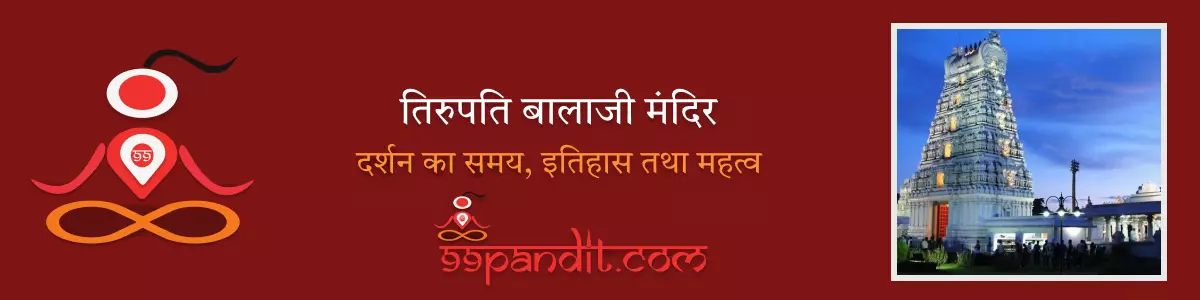
Tirupati Balaji Temple: जाने दर्शन का समय, इतिहास तथा महत्व

हमारे इस भारत देश में हिन्दू धर्म से सम्बंधित बहुत सारे चमत्कारी मंदिर है| आज हम बात करने वाले तिरुपति बालाजी मंदिर (Tirupati Balaji Mandir) के बारे में, जो कि भारत देश के आन्ध्रप्रदेश राज्य में स्थित है| यह मंदिर भारत में उपस्थित चमत्कारी मंदिरों की सूची में आता है| यह मंदिर केवल आंध्र प्रदेश में ही नहीं बल्कि सम्पूर्ण भारत देश में भी बहुत ही अधिक प्रसिद्ध है|

जैसा कि आपको पता ही है कि यह मंदिर आंध्र प्रदेश में है लेकिन तमिलनाडु और कर्नाटक राज्य के लोगों में इस मंदिर के प्रति बहुत आस्था है| इसी कारण से आपको इस मंदिर में सबसे अधिक श्रद्धालु इन्हीं राज्यों के मिलेंगे|

मान्यताओं के अनुसार भगवान तिरुपति बालाजी का मंदिर सर्वाधिक लोकप्रिय माना जाता है| इस तिरुपति बालाजी मंदिर (Tirupati Balaji Temple) में प्रतिदिन हजारों की संख्या में लोग तिरुपति बालाजी के दर्शन करने के लिए आते है तथा बालाजी से अपनी सभी समस्याओं को हल करने के लिए प्रार्थना करते है|

तिरुपति बालाजी मंदिर

यह मंदिर सम्पूर्ण भारत के सबसे पवित्र और सुप्रसिद्ध मंदिरों में शामिल है| यह मंदिर आंध्रप्रदेश राज्य में तिरुपति जिले के तिरुमाला नामक एक पहाड़ी शहर में स्थित है| जिसमे भगवान विष्णु के अवतार भगवान वेंकटेश्वर जी विराजमान माने जाते है|

हिन्दू धर्म की पौराणिक मान्यताओं के अनुसार कहा जाता है भगवान विष्णु ने इस मानवता को कलयुग की परेशानियों व कठिनाइयों से बचाने के लिए भगवान वेंकटेश्वर के रूप में इस धरती पर अवतरित हुए थे| इस तिरुपति बालाजी मंदिर (Tirupati Balaji Temple) में पर्यटकों के आने जाने की संख्या बहुत ही अधिक मात्रा होती है| आपको बता दे कि इस तिरुपति बालाजी मंदिर को पृथ्वी के बैकुंठ के नाम से भी जाना है|

तिरुपति बालाजी मंदिर दर्शन का समय – Timing of Darshan in Tirupati Balaji Temple

क्र.स समय  आयोजन 
1 प्रातः 02:30- प्रातः 03:00 बजे तक सुप्रभात सेवा/अंग प्रदक्षिणम्
2 प्रातः 03:30 – प्रातः 04:00 थोमाला सेवा (एकन्थम)
3 प्रातः 04:00 – प्रातः 04:15 कोलुवु और पंचांग श्रवणम (एकांतम) 
4 प्रातः 04:15 – प्रातः 05:00 प्रथम अर्चना, सहस्र नामर्चना (एकान्तम्)
5 प्रातः 05:00 – प्रातः 08:30 वीआईपी ब्रेक दर्शन : एल1, एल2 (सिफारिश पत्र),
एल3 (कर्मचारी)
6 प्रातः 06:00 – प्रातः 07:00  विशेष पूजा/अस्तादला पाद पद्मराधनमु/  सहस्रकलासाभिषेकम/तिरुप्पावदा,
7 प्रातः 07:00 – प्रातः 07:30  शुद्धि, द्वितीय अर्चना, द्वितीय बेल
8 प्रातः 08:30 – सायं 07:00 बजे तक सर्व दर्शन/दिव्य दर्शन/विशेष प्रवेश दर्शन
9 प्रातः 10:00 बजे  वरिष्ठ नागरिक दर्शन/शारीरिक रूप से विकलांग दर्शन/
रोगी दशान।टिकट सुबह 7:00 बजे तक लेना होगा|
10 दोपहर 12:00 बजे – शाम 05:00 बजे तक  कल्याणोत्सवम/अर्जिथा ब्रह्मोत्सवम/ वसंतोत्सवम/उंजल सेवा (डोलोत्सवम)/सुपदम दर्शन
11 अपराह्न 03:00 बजे  वरिष्ठ नागरिक दर्शन/शारीरिक रूप से विकलांग दर्शन/
रोगी दशान।टिकट दोपहर 12:00 बजे तक लेना होगा|
12 05:30 अपराह्न – 06:30 अपराह्न सहस्त्र दीपलांकरण सेवा
13 07:00 अपराह्न – 08:00 अपराह्न शुद्धि, कैंकर्यम् (एकन्थम),रात्रि घंटी
14 08:00 अपराह्न – 11:30 अपराह्न सर्व दर्शन/दिव्य दर्शन
15 रात्रि 11:30 – 12:00 पूर्वाह्न शुद्धि, एकान्त सेवा की तैयारी
16 12:00 बजे एकांत सेवा


तिरुपति बालाजी मंदिर तक कैसे पहुचे? – How to Reach Tirupati Balaji Temple

यह मंदिर आंध्र प्रदेश में स्थित है| यहाँ पर जाने के लिए बहुत सारे साधन है| जिनके माध्यम से आप तिरुपति के लिए जा सकते है| तिरुपति बालाजी मंदिर (Tirupati Balaji Temple) आप कार, बस, फ्लाइट आदि सभी साधनों से बहुत ही आसानी से जा सकते है| इस लेख में हम आपको जानकारी देंगे कि आप इन तीनों साधनों के माध्यम से किस प्रकार आप तिरुपति बालाजी मंदिर (Tirupati Balaji Temple) जा सकते है| 

फ्लाइट के माध्यम से – By Flight

आपकी जानकारी के लिए बता दे कि तिरुपति बालाजी मंदिर (Tirupati Balaji Temple) के सबसे नजदीक में तिरुपति अन्तराष्ट्रीय हवाई अड्डा है| इस हवाई अड्डे से तिरुपति बालाजी का मंदिर लगभग 17 किलोमीटर दूर है| जिसके लिए आपको टैक्सी या फिर बस के माध्यम से जाना होगा|

99pandit

100% FREE CALL TO DECIDE DATE(MUHURAT)

99pandit

यदि आपके स्थान से तिरुपति  हवाई अड्डे के लिए कोई भी फ्लाइट नहीं है तो आप केम्पेगोड़ा अन्तराष्ट्रीय हवाई अड्डा के लिए फ्लाइट ले सकते है| इस हवाई अड्डे से तिरुपति की दुरी लगभग 250 किलोमीटर है| जिसके लिए आपको टैक्सी या बस की सुविधाएं मिल जाएगी|

ट्रेन के माध्यम से – By Train

तिरुपति जिले में तिरुपति रेलवे स्टेशन है| जो कि विशाखापट्टनम, चेन्नई, हैदराबाद, पूरी, सिकंदराबाद, पांडिचेरी, हजरत निजामुद्दीन, तिरुअनंतपुरम, कोलकाता, नागरकोइल, दिल्ली, जयपुर, अहमदाबाद, हावड़ा, बेंगलुरु, विजयवाड़ा तथा मुंबई के मार्ग से जुड़ा हुआ है|

इन जगहों से तिरुपति के लिए सीधे ही ट्रेने जाती है| इसके पश्चात रेलवे स्टेशन से ही आपको तिरुपति बालाजी मंदिर (Tirupati Balaji Temple) जाने के लिए टैक्सी या बस की सुविधा मिल जाएगी| 

बस के माध्यम से – By Bus

आंध्रप्रदेश सरकार के द्वारा वहां पर विभिन्न स्थानों को जोड़ने के लिए बसों की सुविधाएं की गई है| ताकि किसी भी व्यक्ति को एक स्थान से दुसरे स्थान तक आने जाने में किसी भी प्रकार की कोई भी समस्या ना हो|

इसी वजह से यदि आप इसी राज्य में निवास करते है तो आपको तिरुपति जाने के लिए बस की सुविधा बहुत ही आसानी से प्राप्त हो जायेगी| यदि आप तिरुपति से बहुत ज्यादा दुरी पर रहते है तो हम आपको यही सलाह देंगे कि आपको सफ़र के लिए ट्रेन का साधन चुनना चाहिए, जो कि सर्वश्रेष्ठ माना जाता है| 

तिरुपति बालाजी मंदिर का इतिहास – History of Tirupati Balaji Temple

प्राचीन कथाओं के अनुसार मान्यता थी कि एक बार महर्षि भृगु ऋषि बैकुंठ में पधारे| भृगु ऋषि ने आते ही योग निद्रा में लेटे हुए भगवान विष्णु की छाती पर लात मारी| ऐसा होते ही भगवान विष्णु ने भृगु ऋषि के चरण पकड़ लिए तथा उनसे यह पूछने लगे कि उन्हें कही चोट तो नहीं लगी| लेकिन माता लक्ष्मी जी ऋषि भृगु का ऐसा व्यवहार बिल्कुल भी पसंद नहीं आया|

उनके ऐसे बर्ताव पर भी भगवान विष्णु ने उन्हें कोई दंड नहीं दिया| इस वजह से माता लक्ष्मी उनसे नाराज़ होकर बैकुंठ से चली गयी| इसके पश्चात भगवान विष्णु ने उन्हें खोजने की कोशिश की| उस समय भगवान विष्णु को पता चला कि माता लक्ष्मी ने पृथ्वी पर पद्मवती नाम की कन्या के रूप में जन्म लिया था|

तिरुपति बालाजी मंदिर

तब भगवान विष्णु भी अपना वेश बदलकर पद्मावती जी के पास गए और उनके समक्ष शादी का प्रस्ताव रखा| जिसे देवी ने भी स्वीकार कर लिया| अब जरूरत थी शादी करने के लिए धन की| जिसका समाधान करने के लिए भगवान विष्णु ने भगवान शंकर और ब्रह्मा जी को साक्षी मानकर कुबेर जी धन का कर्ज लिया| भगवान कुबेर के द्वारा दिए गए इस कर्ज से भगवान विष्णु के वेंकटेश्वर तथा माता लक्ष्मी जी के पद्मावती रूप का विवाह सम्पन्न हुआ|

यह मंदिर सबसे लोकप्रिय मंदिर माना जाता है| इस मंदिर में प्रत्येक दिन पर्यटकों तथा श्रद्धालुओं का आना जाना चलता रहता है| यह एक ऐसा धार्मिक स्थान है जहाँ का आकर्षण लोगों को अपनी ओर खींचकर लाता है| तथा एक बार जो भी इस मंदिर में आकर भगवान वेंकटेश्वर के दर्शन कर लेता है तो उस व्यक्ति का मन हमेशा ही यहाँ पर लग जाता है| लोग यहाँ पर बहुत ही दान – पुण्य का कार्य करते है|

तिरुपति बालाजी मंदिर में बालों का दान  

इस मंदिर में लोग दर्शन करने से पूर्व ही अपने द्वारा मांगी हुई मन्नत को पूरा करने के लिए अपने बालों को दान करते है| इस प्रक्रिया को “मोक्कू” भी कहा जाता है| इस प्रथा को करने के लिए मंदिर परिसर में श्रद्धालुओं के लिए एक परिसर अलग से बनाया है| प्रत्येक वर्ष यहाँ पर बहुत सारे बाल इकट्ठे हो जातें है| जिन्हें मंदिर संस्था के द्वारा नीलाम करके बेच दिया जाता है| 

तिरुपति बालाजी मंदिर की महिमा 

इस तिरुपति बालाजी के मंदिर को भूलोक वैकुण्ठं कहा जाता है| जिसका अर्थ होता है – पृथ्वी पर भगवान विष्णु का निवास| इस प्रकार से लोगों का यही मानना है कि कलयुग में भगवान विष्णु अवतार लेंगे तथा अपने सभी भक्तों को इस संसार के माया रूपी जाल से मोक्ष की ओर निर्देशित करेंगे|

यहाँ पर नित्य रूप से भगवान की मूर्ति को सुन्दर कपड़ों तथा गहनों से सुशोभित किया जाता है| इसके अलावा भी मंदिर में अलग से भगवान को सजाने के लिए इस्तेमाल होने वाले सोने के गहनों का भण्डारण है| 

99Pandit ऐसा साधन है जिसके माध्यम से आप गणेश चतुर्थी पूजा, सत्यनारायण पूजा, गृह प्रवेश पूजा आदि कई सारी धार्मिक पूजाओं के लिए ऑनलाइन पंडितजी भी बुक कर सकते है|

तिरुपति बालाजी मंदिर में मनाए जाने वाले त्योहार – Festivals Celebrated in Tirupati Balaji Temple

अब हम इस लेख के माध्यम से जानेंगे कि तिरुपति बालाजी के मंदिर में कौन – कौन से त्यौहार मनाये जाते है| मान्यताओं के अनुसार भगवान तिरुपति बालाजी का मंदिर सर्वाधिक लोकप्रिय माना जाता है|

इस तिरुपति बालाजी मंदिर (Tirupati Balaji Temple) में प्रतिदिन हजारों की संख्या में लोग तिरुपति बालाजी के दर्शन करने के लिए आते है तथा बालाजी से अपनी सभी समस्याओं को हल करने के लिए प्रार्थना करते है|

99pandit

100% FREE CALL TO DECIDE DATE(MUHURAT)

99pandit

हिन्दू धर्म की पौराणिक मान्यताओं के अनुसार कहा जाता है| भगवान विष्णु ने इस मानवता को कलयुग की परेशानियों व कठिनाइयों से बचाने के लिए भगवान वेंकटेश्वर के रूप में इस धरती पर अवतरित हुए थे| आइये जानते है कि वह कौन – कौन से त्यौहार है – 

ब्रह्मोत्सवम: – Brahmotsav

यह तिरुपति बालाजी मंदिर (Tirupati Balaji Temple) में मनाया जाने वाला सबसे महत्वपूर्ण त्यौहार है| यह त्यौहार कुल नौ दिनों तक मनाया जाता है| जिसकी शुरुआत सितम्बर या फिर अक्टूबर के महीने में आ जाती है| इस त्यौहार की शुरुआत “ध्वज स्तंभम”  नामक एक खम्भे पर झंडे को फहराने से की जाती है| इस त्यौहार सभी भक्तों के द्वारा बहुत ही खुशहाली और भक्ति के भाव से मनाया जाता है|

वैकुंठ एकादशी:Vaikunth Ekadashi

यह त्यौहार भी तिरुपति बालाजी मंदिर (Tirupati Balaji Temple) में मनाया जाने महत्वपूर्ण त्योहारों में से ही एक है| इस त्योहार को दिसम्बर या जनवरी  तक मनाया जाता है| हिन्दू धर्म की मान्यताओं के अनुसार इस दिन बैकुंठ के द्वार सभी भक्तों के लिए खोल दिए जाते है| इस दिन भगवान वेंकटेश्वर के मंदिर को फूलों से सजाया जाता है| तथा भगवान वेंकटेश्वर बहुत ही विशेष पूजा की जाती है| 

रथसप्तमी: – Rath Saptami

यह त्यौहार फरवरी के महीने में मनाया जाता है| रथसप्तमी का त्यौहार चंद्रमा के बढ़ते हुए चरण को दर्शाता है तथा यह सूर्य देव को समर्पित किया गया है| माना जाता है कि इस दिन सूर्य भगवान अपनी दिशा दक्षिण पूर्व से उत्तर पूर्व की और बदल जाता है| इसी कारण इस दिन से वसंत ऋतू का आरम्भ हो जाता है| 

उगादि: – Ugaadi

तेलगु नव वर्ष को ही उगादि के नाम से भी जाना जाता है जो कि मार्च या अप्रैल के महीने में मनाया जाता है| तेलगु लोग इस त्यौहार को बहुत ही हर्षोल्लास के साथ मनाते है| इस शुभ अवसर पर भगवान तिरुपति के मंदिर को आम का पत्तों की सहायता से सजाया जाता है| इस त्यौहार की मुख्य प्रथा “पंचांग श्रवणं” है जिसमे पुजारी ज्योतिष विद्या की सहायता से आगे के समय में होने वाली घटनाओं की भविष्य वाणी करते है| 

हमारे इस ऑनलाइन प्लेटफार्म 99Pandit की सहायता से आपको नए घर की वास्तु शांति पूजा के लिए आपके ही शहर में अनुभवी पंडित उपलब्ध हो जाएंगे| 

तिरुपति बालाजी मंदिर के आसपास के दर्शनीय स्थल – Places to Visit Near Tirupati Balaji Temple


1. श्री वेंकटेश्वर राष्ट्रीय उद्यान – Shri Venkateswara National Park

तिरुपति के वनस्पतियों तथा जीवों के बारे में जानने के लिए आपको एक बार इस, श्री वेंकटेश्वर राष्ट्रीय उद्यान पर अवश्य ही आना चाहिए| इस राष्ट्रीय उद्यान को शोरिया थंबर्गगिय, रेड सैंडर्स तथा चन्दन जैसे दुर्लभ पौधों का घर माना जाता है| 

2. श्री पद्मावती अम्मावरी मंदिर – Shri Padmavati Ammavari Temple

यह मंदिर तिरुमाला के पहाड़ी क्षेत्र में स्थित है| इसे पर्यटकों द्वारा घुमने के लिए सबसे लोकप्रिय स्थान माना गया है| यह श्री पद्मावती अम्मावरी मंदिर भगवान वेंकटेश्वर की पत्नी पद्मावती जी को ही समर्पित किया गया है|

तिरुपति बालाजी मंदिर

3. कपिला तीर्थम – Kapila Tirtham

अगर आप तिरुपति के आस – पास कोई घूमने योग्य स्थान की तलाश कर रहे है तो आपके लिए कपिला तीर्थम एक बहुत अच्छी जगह है| यह स्थान पवित्र होने के साथ ही उस धारा के नाम से भी जाना जाता है जो की भगवान शंकर को समर्पित इस मंदिर के पास बहती है|

4. हिरण पार्क – Deer Park

तिरुपति के निकट घुमने योग्य स्थानों में हिरण पार्क भी शामिल है| तिरुमाला की पहाड़ी के आधार पर स्थित यह पार्क बहुत ही बड़ी संख्या में हिरणों, मोर तथा अन्य जीवों का आवास माना गया है| यहाँ आने वाले पर्यटक पार्क में घूम सकते है, जानवरों को खाना खिला सकते है तथा वहां के सुन्दर दृश्य का आनंद ले सकते है| 

5. सिला थोरनाम – Sila Thornam

चित्तूर जिले में स्थित यह स्थान एक पत्थरों के मेहराब के रूप में है| यह स्थान तिरुपति के सबसे प्रसिद्ध पर्यटक स्थानों में से एक है| यह स्थान अपनी विशेष वास्तुकला के बारे में जाना जाता है| 

निष्कर्ष – Conclusion

आज हमने इस आर्टिकल के माध्यम से तिरुपति बालाजी मंदिर (Tirupati Balaji Temple) के बारें में काफी बाते जानी है| आज हमने तिरुपति बालाजी पूजन के फ़ायदों के बारे में भी जाना तथा वहां तक जाने के लिए साधनों के बारे में भी बात की|

हम उम्मीद करते है कि हमारे द्वारा बताई गयी जानकारी से आपको कोई ना कोई मदद मिली होगी| इसके अलावा भी अगर आप किसी और पूजा के बारे में जानकारी लेना चाहते है। तो आप हमारी वेबसाइट 99Pandit पर जाकर सभी तरह की पूजा या त्योहारों के बारे में सम्पूर्ण जानकारी ले सकते है| 

अगर आप हिन्दू धर्म से सम्बंधित किसी पूजा जैसे – वाहन पूजा, भूमि पूजा इत्यादि हेतु पंडित जी की तलाश कर रहे है तो आपको बता दे की 99Pandit पंडित बुकिंग की सर्वश्रेष्ठ सेवा है जहाँ आप घर बैठे मुहूर्त के हिसाब से अपना पंडित ऑनलाइन आसानी से बुक कर सकते हो।

यहाँ  बुकिंग प्रक्रिया बहुत ही आसान है| बस आपको Book a Pandit विकल्प का चुनाव करना होगा और अपनी सामान्य जानकारी जैसे कि अपना नाम, मेल, पूजन स्थान , समय,और पूजा का चयन के माध्यम से आप आपना पंडित बुक कर सकेंगे|

अक्सर पूछे जाने वाले प्रश्न – FAQs

Q.तिरुपति में सबसे ख़ास क्या है ?

A.इस मंदिर में भगवान वेंकटेश्वर की प्रतिमा बहुत ही ख़ास और आलोकिक है|

Q.तिरुपति बालाजी मंदिर कहा स्थित है ?

A.यह मंदिर आंध्रप्रदेश राज्य में तिरुपति जिले के तिरुमाला नामक एक पहाड़ी शहर में स्थित है|

Q.तिरुपति बालाजी मंदिर का मालिक कौन है ?

A.यह मंदिर तिरुमला तिरुपति देवस्थानम (TTD) के द्वारा संचालित किया जाता है, जो कि आंध्र प्रदेश सरकार के नियंत्रण में है|

Q.तिरुपति बालाजी मंदिर कब जाना चाहिए ?

A.ऐसे तो आप कभी भी तिरुपति बालाजी मंदिर जा सकते है| लेकिन सबसे सही समय अक्टूबर से मार्च के बीच होता है|

Sree Padmanabhaswamy Temple Trivandrum: Timings, Entry Fee, & Informations

Sree Padmanabhaswamy temple is one of the most important temples in the Hindu religion. Sree Padmanabhaswamy Temple is also known as the Sree Anantha Padmanabhaswamy Temple. It is dedicated to Lord Anantha, an avatar of Lord Vishnu.

The temple is located in Thiruvananthapuram. Thiruvananthapuram means ‘The land of Lord Anantha’. Sree Padmanabhaswamy temple is one of the most 108 holy temples of Lord Vishnu. It is one of the richest temples in the world. The hidden treasure located in the temple has amazed people from time to time.

Sree Padmanabhaswamy Temple

Know more about the Sree Padmanabhaswamy temple with the help of 99Pandit.

Timing 

Sree Padmanabhswamy Temple is one of the most important temples in the Hindu religion. Timings for visiting the Sree Padmanabhswamy temple are listed.

Day  Timings 
Monday  Morning: 3:15 Am – 12:00 Noon
Evening: 5:00 Pm – 7:20 Pm 
Tuesday  Morning: 3:15 Am – 12:00 Noon
Evening: 5:00 Pm – 7:20 Pm 
Wednesday  Morning: 3:15 Am – 12:00 Noon
Evening: 5:00 Pm – 7:20 Pm
Thursday  Morning: 3:15 Am – 12:00 Noon
Evening: 5:00 Pm – 7:20 Pm
Friday  Morning: 3:15 Am – 12:00 Noon
Evening: 5:00 Pm – 7:20 Pm
Saturday  Morning: 3:15 Am – 12:00 Noon
Evening: 5:00 Pm – 7:20 Pm
Sunday  Morning: 3:15 Am – 12:00 Noon
Evening: 5:00 Pm – 7:20 Pm

The Sree Padmanabhswamy temple lists morning darshan timings.

  • 3:15 AM to 4:15 AM 
  • 6:30 AM to 7:00 AM 
  • 8:30 AM to 10:00 AM 
  • 10:30 AM to 11:10 AM 
  • 11:45 AM to 12 Noon 

The Sree Padmanabhaswamy temple lists the evening darshan timings.

  • 5:00 PM to 6:15 PM 
  • 6:45 PM to 7:20 PM

About Sree Padmanabhaswamy Temple

Sree Padmanabhaswamy temple is one of the most important temples in the Hindu religion. The architecture of the temple is an amalgam of the Dravidian style and the Kerala style. A 100-foot-tall gopuram is located at the entrance of the temple. An eighteen-foot idol of the principal deity lying in the Ananthasayanam posture on Adi Shesha is located in the main shrine of the temple. 

The devotees do not know the date of foundation of the Sree Padmanabhswamy temple. As per the beliefs of the devotees, the temple was established 5000 years ago. The temple records written on palm leaves mention that sage Vilwamangalam founded the Sree Anantha Padmanabhswamy Temple.

99pandit

100% FREE CALL TO DECIDE DATE(MUHURAT)

99pandit

Sage Vilwamangalam performed rituals at the Kasargod Padmanabhaswamy temple also known as the Ananthapura Lake temple. It is said that Sree Anantha Padmanabhaswamy’s original seat (Moolsthanam) is the temple.

Legend About Sree Padmanabhaswamy Temple 

Lord Vishnu appeared as an orphan kid before Sage Vilwamangalam. The sage felt pity for the kid and allowed him to stay at the temple. He helped sage Vilwamangalam in the daily activities of the temple. One day Sage Vilwamangalam treated the boy harshly. 

The boy ran towards the forest. Sage Vilwamangalam realized that the boy was Lord Vishnu himself. He went to find him and followed him inside a cave. This led to the founding of present-day Thiruvananthapuram. The boy disappeared inside a mahua tree. The tree fell and took the form of Lord Vishnu lying on AdiShesha (thousand-hooded serpent). 

The size of Lord Vishnu in the Ananthasayanam posture was more than eight miles. Sage Vilwamangalam requested the Lord to consider taking a smaller size. Lord Vishnu took a smaller size but sage Vilwamangalam still could not see him completely. 

Trees were obstructing the view. Sage Vilwamangalam could see Lord Vishnu in three parts – the face part, the stomach part, and the feet part. The doors of the Sree Padmanabhaswamy temple in Trivandrum show the idol in the same way as the sage Vilwamangalam saw Lord Vishnu. 

History of Sree Padmanabhaswamy Temple 

The exact date of construction of the Sree Padmanabhswamy temple is not known. The earliest mention of the temple is from the 9th century. The roof of the sanctum sanctorum of the temple was repaired in the fifteenth century. 

The Ottakkal mandapam in the Sree Padmanabhswamy temple was built during the same time. During the middle of the seventeenth century, King Anizham Thirunal Marthanda Varma helped in performing major renovations in the temple.

Sree Padmanabhaswamy Temple

Later, the sanctum sanctorum of the temple was reconstructed. The old idol of the temple was replaced by a statue made with 12008 Shaligram stones and various herbs collectively called Katu-sharkara.

Work on the statue of the temple was completed in 1739. A stone corridor, gate, and flagstaff were also built. He dedicated his kingdom to Lord Sree Padmanabhaswamy in the year 1750.  

King Karthika Thirunal Rama Varma built the pillared outdoor hall of the temple known as Karthika Mandapam in 1758. During the time of Queen Gowri Parvathi Bayi, artists drew the Anantha Shayan mural inside the temple in the year 1820.

A major event in the history of Sree Padmanabhaswamy temple was noted in the year 1936 during the reign of Chithira Thirunal Rama Varma. He allowed every Hindu caste in the temple. This was called Kshetra Pravesham Vilambram. 

Entry Fee and Puja Cost

Sree Padmanabhswamy temple is one of the most important temples in the Hindu religion. Entry into the temple is free for the devotees. They need to pay the fee for a special darshan. Devotees have to pay 150 rupees for special darshan without prasadam and 180 rupees with prasadam. 

Devotees can purchase special Sree Padmanabhaswamy temple darshan tickets at the ticket counter. They can skip long queues by purchasing the darshan tickets from the counter. The cost of entry for two people is 250 rupees along with the puja thali. Kids can enter the temple for free.  

Devotees can take part in special puja rituals performed in the temple complex by booking a seat in advance. Perform Nirmalayam to Deeparadhana from 3:30 Am to 4:45 Am. Temple price it at 3000 Rupees.

99pandit

100% FREE CALL TO DECIDE DATE(MUHURAT)

99pandit

The temple performs Nirmalyam to Usha Puja from 3:30 am to 5:30 am and prices it at 4000 Rupees. The Pandits perform Nirmalyam to Pantheeradi Puja from 3:30 Am to 6 Am, and the price is 5000 rupees. Additionally, Nirmalyam to Ucha Puja is performed for half a day. It can be booked with a payment of 12000 rupees. 

Devotees can also purchase offerings like aravana, payasam, and unniyappam. They can offer these offerings to Sree Padmanabhaswamy, Sree Narsimhaswamy, Shri Krishna Swamy, and other deities in the temple complex. 

Dress Code 

The dress code for Sree Padmanabhaswamy temple includes Dhoti/Mundu for men. They have to wrap the dhoti in the lower half of the body. The upper half of the body can be kept bare. Devotees usually cover the upper half of the body with angavastram (shawl). Young boys have to follow the same dress code as men. 

Women can wear a Saree/Pavada/Dhoti along with a blouse to the temple complex. They can also wear a T-shirt along with a long Skirt/Lehenga. The same rules apply to young girls. Devotees can wrap dhoti over Jeans/Pants/Salwars to match the dress code. 

Shrines inside Sree Padmanabhaswamy Temple 

Devotees regard Sree Padmanabhaswamy temple as Maha – kshetram (Great Temple) because of the historical importance and spiritual significance of the temple. 

Sree Padmanabhaswamy Shrine

The eighteen-foot katu – sharkara idol of Lord Padmanabhswamy resting on Adi Shesha serpent is located inside the main shrine. The idol is composed of 12008 Shaligrams. People view it through the three doors of the sanctum. 

Devotees can the face and upper body of the deity through the first door. The right hand of the deity rests on a Shiva lingam. The idols of Devi Lakshmi and Devi Bhumi surround the idol of Sree Padmanabhaswamy.

Sree Padmanabhaswamy Temple

The presence of Lord Shiva inside the sanctum sanctorum adds to the sanctity of the Padmanabhaswamy temple dedicated to Lord Vishnu. Artists painted images of Lord Shiva on the walls and other parts of the temple.  

The second door of the Sree Pandmanabhaswamy temple provides a glimpse of Lord Brahma emerging from the naval of the Anantha Padnabhaswamy deity. Devotees can see the feet of the deity from the third door of the temple. 

Lord Ganesh Shrine 

The temple complex has a shrine dedicated to Lord Ganesh. Devotees worship Lord Ganesh in the form of an elephant God. Devotees worship Lord Ganesh before performing any important ritual. 

Lord Narsimha Shrine 

The temple complex has shrines of other deities also. One shrine dedicates itself to Lord Narasimha. Lord Narasimha is part Lion and part man avatar of Lord Vishnu.  

Lord Krishna Shrine 

The temple complex has a shrine dedicated to Lord Krishna. An important shrine is built in honour of Parthasarathy. Lord Krishna in the form of the role of charioteer of Arjun is known as Parthasarathy. Lord Krishna is an avatar of Lord Vishnu. 

Ram Shrine 

The temple complex has a shrine dedicated to Lord Ram. Lord Ram is accompanied by Devi Sita, Lord Ram’s brother Lakshman, and Lord Hanuman. 

Thiruvambadi Sree Krishnaswamy Temple 

The temple premises of Sree Padmanabhswamy temple has a separate Thiruvambadi Krishnaswamy temple. This temple has a separate flagstaff. The temple performs separate rituals and rites.

Important Attractions within Sree Padmanabhaswamy Temple

In addition to the shrines within the Sree Padmanabhaswamy temple complex, there are other attractions also within the temple complex. 

Kulasekhara Mandapam

The structure of Kulasekhara Mandapam is an architectural marvel present within the temple complex. Builders built it with stone and supported it with 28 pillars. These pillars produce musical notes when someone taps them. People also know this mandapam as Sapthaswara mandapam or Aayiramkaal mandapam. 

Abhisravana Mandapam 

It is a stone structure present in the temple complex. It is present in front of the Ottakkal mandapam. Devotees use this mandapam to meditate and pray to the Lord. Special pujas use it during festivals celebrated in the temple.

Dhwaja Stambham 

The dhwaja stambham is an 80 feet high staff present in the temple complex. It is present near the Eastern corridor. Craftsmen made this stambham from teak wood and covered it with gold foil. The top part of the dhwaja stambham has a figure of Garuda Swamy in a kneeling posture. Garud Swamy is the vehicle of Lord Anantha Sree Padmanabhaswamy.

99pandit

100% FREE CALL TO DECIDE DATE(MUHURAT)

99pandit

The architects built Sreebalippura, a magnificent corridor made up of stone. Monolith pillars are present on this corridor. The Sreebali procession takes through the Sreebalippura corridor during the festivals of Painkuni and Alpasi.

Sree Padmanabhaswamy Temple Pond 

It is one of the most sacred ponds in Trivandrum. Padmatheertham Pond is present on the eastern side of the Sree Padmanabhaswamy temple. Eight mandapams of the temple complex are present in the Padmatheertham pond. 

Important Information 

Time Required to Visit Sree Padmanabhaswamy Temple 

Devotees need about 2-3 hours to get the darshan of Sree Padmanabhaswamy and other deities in the temple. If they purchase special darshan tickets, they can get past long queues in less time. 

Best Time to Visit Sree Padmanabhaswamy Temple 

Winter season, October to February, is the best time to visit Sree Padmanabhaswamy temple. The temperature is pleasant to spend some hours at the temple. It is too humid during the summer and monsoon months for a comfortable visit to the temple.

Final Glimpse 

Sree Padmanabhaswamy temple is one of the most important temples in India. It is located in Trivandrum (Thiruvananthapuram) in the state of Kerala. People also know the temple as Maha Khsetram.

The temple dedicates the main shrine to Sree Anantha Padmanabhaswamy. There are other shrines also present in the temple complex. Entry inside the temple is free. Devotees have to pay charges for special darshan. 

Devotees can also perform pujas and rituals by booking their seats by making a payment. The best time to visit Sree Padnabhaswamy temple is in the winter months.   

Frequently Asked Questions

Q.What is Sree Padmanabhaswamy temple?

A.Sree Padmanabhaswamy temple is one of the most important temples in India. It is located in Thiruvananthapuram, Kerala. Devotees visit Sree Padmanabhaswamy temple from all the parts of India to seek the blessings of Sree anantha Padmanabhaswamy.

Q.What are the timings of Sree Padmanabhaswamy temple?

A.Devotees can visit Sree Padmanabhaswamy temple in the morning and also in the evening. In the morning, the temple is open from 3:15 am till 12 noon. In the evening, the temple remains open from 5 pm till 7:20 pm.

Q.What is the entry fee for Sree Padmanabhaswamy temple?

A.Entry inside Sree Padmanabhaswamy temple is free. Devotees have to pay 150 – 180 rupees for special darshan.

Q.Where is the Sree Padmanabhaswamy temple located?

A.Sree Padmanabhaswamy temple is located in Thiruvananthapuram (Trivandrum). Thiruvananthapuram is located in Kerala.


Shani Shingnapur Temple: पौराणिक कथा, मंदिर दर्शन व यात्रा की जानकारी

भगवान शनि देव को समर्पित यह शनि शिंगणापुर मंदिर (Shani Shingnapur Temple) का मंदिर सम्पूर्ण अहमदनगर जिले का सबसे प्राचीन और प्रसिद्ध मंदिर माना गया है| शनि शिंगणापुर (Shani Shingnapur) गाँव में माना जाता है कि इस स्थान पर भगवान शनि देव एक काले पत्थर के रूप में निवास करते है|

शनि शिंगणापुर मंदिर में शनि देव का यह मंदिर प्रत्येक वर्ष हजारों श्रद्धालुओं को अपनी ओर आकर्षित करता है| यहाँ पर रहने वाले लोगों में भगवान शनि देव के प्रति बहुत अटूट आस्था है| यहाँ के लोग शनि देव पर इतना अटूट विश्वास करते है कि इस गाँव में कोई भी व्यक्ति अपने घर पर ताला नहीं लगाता है|

इस गाँव के लोगों का यह मानना है कि भगवान शनि देव उनके घर की स्वयं ही रक्षा करते है| उस गाँव में कभी भी चोरी नहीं होती है| माना जाता है कि जो भी चोर शनि शिंगणापुर गांव में चोरी करता है तो भगवान शनि देव उसे स्वयं ही दंड देते है|

शनि शिंगणापुर मंदिर

शनि शिंगणापुर मंदिर के लोग अमावस्या, शनिवार तथा श्री शनैश्चर जयंती जैसे शुभ अवसरों को बहुत ही खुशहाली तथा पूर्ण उत्साह के साथ आयोजित करते है| आपकी जानकारी के लिए बता दे कि शनि शिंगणापुर (Shani Shingnapur Temple) में भगवान शनि देव के मंदिर में महिलाओं का जाना वर्जित माना जाता है|

भगवान शनि देव उस व्यक्ति के जीवन से सभी प्रकार के कष्टों को दूर कर देते है| इसके अलावा हम आपको बता दे कि आप अपने घर में भी नवग्रह शांति पूजा के लिए पूजा कर सकते है| इस पूजा के लिए आप 99Pandit for User एप या वेबसाइट से ऑनलाइन पंडित जी बुक कर सकते है|

शनि शिंगणापुर मंदिर कैसे पहुंचे? How to Reach Shani Shingnapur

यह मंदिर पूर्ण रूप से भगवान शनि देव को समर्पित किया गया है| शनि शिंगणापुर का यह प्राचीन स्थान सम्पूर्ण भारत देश तथा हिन्दू धर्म के सबसे प्रमुख स्थानों में से एक माना जाता है| भगवान शनि देव का यह पवित्र स्थान महाराष्ट्र में स्थित शिरडी से लगभग 70 किलोमीटर की दुरी पर स्थित है|

माना जाता है कि शिरडी से शनि शिंगणापुर मंदिर तक जाना बहुत ही आसन है| ऐसा इसलिए है क्योंकि शिरडी में साईं बाबा के आश्रम से सुबह 4 बजे से ही शनि शिंगणापुर (Shani Shingnapur) के लिए निजी बसे, टैक्सी, रिक्शा आदि वाहन तैयार रहते है|

99pandit

100% FREE CALL TO DECIDE DATE(MUHURAT)

99pandit

जिनमे से शेयरिंग गाडी प्रत्येक व्यक्ति के 120 रू लेता है| इसके अलावा ऑटो 250 रू. प्रति सवारी तथा टेम्पो वाले 100 रू. प्रति व्यक्ति के हिसाब से पैसे लेते है| आगे इस लेख के माद्यम से हम आपको बतायेंगे कि आप तीनों मार्ग (वायु, ट्रेन तथा सड़क) से किस प्रकार शनि शिंगणापुर (Shani Shingnapur) तक पहुँच सकते है| 

वायु मार्ग से शनि शिंगणापुर –  Shani Shingnapur By Air 

शनि शिंगणापुर वायु मार्ग से जाने के लिए आपको अपने शहर से ,शनि शिंगणापुर से 80 से 82 किमी दूर स्थित शिरडी हवाई अड्डे के लिए एक फ्लाइट लेनी होगी| जो कि शनि शिंगणापुर (Shani Shingnapur) से सबसे नजदीक है तथा लगभग सभी शहरों से शिरडी हवाई अड्डे के लिए फ्लाइट्स बहुत ही आसानी से मिल जाती है|

यदि किसी कारणवश आपको शिरडी के लिए फ्लाइट ना मिले तो आप शनि शिंगणापुर के 90 किमी. दूर औरंगाबाद के एयरपोर्ट पर या 144 किमी. दूर नासिक हवाई अड्डे पर भी जा सकते है| इसके पश्चात आपको हवाई अड्डे से निजी बसे तथा टैक्सी की सुविधा मिल जाएगी| जिसके द्वारा आप शनि शिंगणापुर तक आसानी से जा सकते है|

ट्रेन से शनि शिंगणापुर – Shani Shingnapur By Train 

आपकी जानकारी के लिए बता दे कि वर्तमान के समय शनि शिंगणापुर (Shani Shingnapur) में रेलवे स्टेशन की सुविधा नहीं है| इस वजह से यदि आप ट्रेन के द्वारा शनि शिंगणापुर जाना चाहते है तो आपको यह पहुँचने के लिए राहुरी रेलवे स्टेशन, जो कि शनि शिंगणापुर (Shani Shingnapur) से 32 किमी.दूर है|

इसके अलावा अहमदनगर 35 किमी. दूर, श्रीरामपुर 54 किमी. दूर तथा शिरडी रेलवे स्टेशन शनि शिंगणापुर से लगभग 85 किमी. की दूरी पर स्थित है| इन सभी स्टेशनों की रेलवे लाइन लगभग सभी शहरों से जुड़ी हुई है| इनमे से किसी भी स्टेशन पर पहुंच कर आपको शनि शिंगणापुर (Shani Shingnapur) के लिए टैक्सी या बहुत सारे अन्य साधन मिल जाएंगे|

सड़क मार्ग से शनि शिंगणापुर – Shani Shingnapur By Road

भगवान शनि देव के निवास स्थान शनि शिंगणापुर (Shani Shingnapur) का रास्ता भारत देश के लगभग सभी शहरों से जुड़ा हुआ है| इसलिए आपको महाराष्ट्र तथा इसके आस – पास के राज्यों से आपको एसी तथा नॉन एसी बसों की सुविधा मिल जाएगी|

जिससे आप सुबह जल्दी शनि शिंगणापुर (Shani Shingnapur) में जाकर भगवान शनि देव के दर्शन कर सकते है| शनि शिंगणापुर के पास में ही शिरडी भी आता है| जहाँ पर साईं बाबा का मंदिर है| आप इस मंदिर के भी दर्शन कर सकते है और शाम उसी बस से आप पुनः अपने शहर वापिस लौट सकते है| 

शनि शिंगणापुर कब जाना चाहिए – When Should One go to Shani Shingnapur 

आपको बता दे कि शनि शिंगणापुर (Shani Shingnapur) जाने का कोई निर्धारित समय नहीं बताया गया है| माना जाता है कि शनि शिंगणापुर मंदिर में भगवान शनि देव के दर्शन करने के लिए सभी लोग मौसम के अनुसार जाते है| यहाँ जाने के लिए सबसे अच्छा समय सितंबर से मार्च महीने के मध्य में माना जाता है|

गर्मी के समय में शनि शिंगणापुर (Shani Shingnapur) का तापमान 40 से 44 डिग्री तक चला जाता है और बारिश के समय यहां तक आने वाले रास्तों में नदी-नाले उफान मारते है| जिस वजह से लोगों को आने जाने में बहुत समस्या होती है|

शनि शिंगणापुर मंदिर

इसलिए सितम्बर से मार्च के बीच का समय शनि शिंगणापुर जाने के लिए बहुत अच्छा समय बताया गया है क्योंकि इस समय ना तो ज्यादा गर्मी होती है और ना ही अधिक बारिश| शनि शिंगणापुर (Shani Shingnapur) में दुसरे दिनों की अपेक्षा छुट्टी वाले दिन तथा प्रत्येक शनिवार को बहुत ही अधिक भीड़ देखने को मिलती है|

इसके अलावा हम बात करे कि यदि आप को शनि शिंगणापुर में ठहरने की सुविधा चाहिए तो आपको बता दे शनि शिंगणापुर में देवस्थान की तरफ से श्रद्धालुओं के लिए यहाँ रहने की व्यवस्था कर रखी है| शनि शिंगणापुर (Shani Shingnapur) में रहने के साथ साथ भोजन की व्यवस्था भी जाती है| भोजन करने के लिए आपको टोकन की आवश्यकता भी होगी| 

शनि शिंगणापुर से जुड़ी पौराणिक कथा

एक प्राचीन कथा के अनुसार बताया गया है कि आज के समय से लगभग 400 साल पहले शनि शिंगणापुर में बहुत ही भयानक वर्षा का प्रकोप छाया हुआ था| उस समय वर्षा इतनी तेजी से हो रही थी कि कुछ ही समय में वहां पर बाढ़ आ गयी थी| माना जाता है कि इस तेज बारिश में एक श्याम वर्णीय पाषण शिला बेर के वृक्ष में अटक गयी|

इसके पश्चात जब बारिश रुकी, उस समय वहां से जा रहे एक चरवाहे उस शिला को देखा| जिसके बाद में उसने अपने लड़कों को भी वहां बुलाया| जब चरवाहे ने उन लड़को के साथ मिलकर उस शिला को खुरेदने की कोशिश की तो उन्होंने देखा कि उस पाषण शिला में घाव हो गया तथा उस घाव में से रक्त भी बह रहा था|

जिससे वह लोग घबरा गए तथा सभी गाँव वालो को इस बात से अवगत करवाया| जिसके पश्चात सम्पूर्ण गाँव के लोग उस शिला को देखने के लिए पहुचे तथा उसे हैरान हो गए| कुछ समय बाद सभी अपने – अपने घर चले गए| तब शनिदेव ने एक व्यक्ति के सपने में आकर अपने प्रकट होने बारे में सभी बातें  बता दी|

99pandit

100% FREE CALL TO DECIDE DATE(MUHURAT)

99pandit

अगले दिन उस व्यक्ति ने भी सभी गाँव वालो पूर्ण बात बता दी और सभी लोग उस शिला को गाँव में स्थापित करने के लिए उसे लेने के लिए गए , किन्तु वह शिला किसी भी व्यक्ति से नहीं उठी| फिर उस व्यक्ति सपना आया तो शनि देव ने उससे कहा कि मुझे सिर्फ वही लोग उठा सकते है, जिनका सम्बन्ध मामा – भांजे का हो|

इसके पश्चात शिला को उठाते समय उस भक्त ने अपने मन में ही उस प्रतिमा रूपी शिला को अपने खेत में रखे बारे सोचा| उसके ऐसा सोचने की वजह से वह शिला वहां से नहीं हिली अर्थात उसी स्थान पर फिर से स्थिर हो गयी| कुछ समय के पश्चात गाँव में एक स्थान पर हलचल हुई|

गाँव के लोगों ने इसे भगवान शनि देव का ही कोई इशारा मान कर उस शिला रूपी प्रतिमा को उसी स्थान पर स्थापित कर दिया जहाँ पर हलचल हुई थी| इसके बाद भगवान शनि देव की कृपा से एक व्यक्ति को पुत्र रत्न की प्राप्ति हुई तो वह इस ख़ुशी में उस प्रतिमा के चारों ओर चबूतरे का निर्माण भी करवाया| इसलिए कहा जाता है कि शनि देव यह शिला जितनी बाहर है, उतनी ही अन्दर है| 

शनि शिंगणापुर मंदिर दर्शन – Shani Shingnapur Temple Darshan

आपको बता दे कि शनि शिंगणापुर (Shani Shingnapur) मंदिर दर्शन हेतु सभी श्रद्धालुओं के 24 घंटे ही खुला रहता है| ताकि शनि देव के भक्त उनके दर्शन कभी भी कर सके| आप कभी भी शनि शिंगणापुर में भगवान शनि देव के दर्शन कर सकते है| इसी के साथ आपको एक चीज़ के बारे में सचेत कर दे कि अब यहाँ पर बहुत सारी प्रसाद की दुकाने बन गयी|

शनि शिंगणापुर मंदिर

जहाँ से यदि आप प्रसाद खरीदते है तो आपको प्रसाद की एक टोकरी हाथ पकड़कर तथा कुछ मंत्र पढ़कर उस प्रसाद के आपसे 500 रू. ले लिए जाएँगे| इस स्थान पर आपको थोडा सा तेल भी बहुत महंगा दिया जाएगा तो इस संदर्भ में हम आपको यही सलाह देंगे कि भगवान शनि देव को चढ़ाने के लिए तेल एवं प्रसाद शिंगणापुर से पहले ही खरीद ले|

इसके पश्चात जब आप भगवान शनि शनि देव के दर्शन के लिए जब आप मन्दिर की लाइन में लगते है तो उस समय आपको अपने मन में ॐ शं शनैश्चराय नम: मंत्र का जप करते रहिये| इसी प्रकार लाइन में धीरे – धीरे आगे बढ़ते हुए आपको खुले आसमान तथा चारों ओर चबूतरे से घिरे हुए शनि देव जी पाषण प्रतिमा के दर्शन होंगे|

मंदिर में उपस्थित प्रतिमाएं

भगवान शनि देव की यह प्रतिमा लगभग 5 फीट 9 इंच ऊँची तथा 1 फीट 6 इंच चौड़ी मानी जाती है| इस मंदिर की एक विशेष बात यह है कि इस मंदिर में दुसरे मंदिरों की भांति दिवार या छत नहीं है| हमारे द्वारा तेल रिफाइन होकर प्रतिमा के ऊपर लगे हुए तांबे के पात्र की सहायता से प्रतिमा के उप्पेर बूंद – बूंद करके चढ़ता रहता है| 

आपको बता दे कि इस मंदिर में भगवान शनि के साथ – साथ भगवान शंकर, नंदी महाराज तथा हनुमान जी की भी प्रतिमा लगी हुई है| माना जाता है कि सबसे पहले व्यक्ति को भगवान शनि देव की पूजा करनी चाहिए|

99pandit

100% FREE CALL TO DECIDE DATE(MUHURAT)

99pandit

जिससे की व्यक्ति के जीवन कभी शनि देव की साढ़े साती ना लागे तथा इनके जीवन में किसी भी प्रकार की कोई भी समस्या नहीं आ पाए| इसके पश्चात हनुमान जी की पूजा करे| माना जाता है कि भगवान शनि देव और हनुमान जी की साथ में पूजा से भक्तों को पुण्य की प्राप्ति होती है| 

मंदिर में महिलाओं के प्रवेश नियम  

जैसा कि आपको पता ही होगा कि पिछले 400 वर्षों से शनि शिंगणापुर (Shani Shingnapur) मंदिर में महिलाओं के जाने पर रोक लगा रखी थी| लेकिन 7 साल पहले महिलाओं के द्वारा किये गए विरोध के कारण 8 अप्रैल 2016 को अदालत के आदेश की वजह से मंदिर में महिलाओं के प्रवेश की अनुमति मिल गयी|

निष्कर्ष 

आज हमने इस आर्टिकल के माध्यम से शनि शिंगणापुर (Shani Shingnapur) मंदिर के बारें में काफी बाते जानी है| आज हमने शनि शिंगणापुर पूजन के फ़ायदों के बारे में भी जाना तथा वहां तक जाने के लिए साधनों के बारे में भी बात की|

हम उम्मीद करते है कि हमारे द्वारा बताई गयी जानकारी से आपको कोई ना कोई मदद मिली होगी| इसके अलावा भी अगर आप किसी और पूजा के बारे में जानकारी लेना चाहते है। तो आप हमारी वेबसाइट 99Pandit पर जाकर सभी तरह की पूजा या त्योहारों के बारे में सम्पूर्ण जानकारी ले सकते है| 

यदि आप हिन्दू धर्म से सम्बंधित किसी पूजा जैसे – वाहन पूजा, भूमि पूजा इत्यादि हेतु पंडित जी की तलाश कर रहे है तो आपको बता दे की 99Pandit पंडित बुकिंग की सर्वश्रेष्ठ सेवा है जहाँ आप घर बैठे मुहूर्त के हिसाब से अपना पंडित ऑनलाइन आसानी से बुक कर सकते हो|

यहाँ  बुकिंग प्रक्रिया बहुत ही आसान है| बस आपको Book a Pandit विकल्प का चुनाव करना होगा और अपनी सामान्य जानकारी जैसे कि अपना नाम, मेल, पूजन स्थान , समय,और पूजा का चयन के माध्यम से आप अपना पंडित बुक कर सकेंगे|

अक्सर पूछे जाने वाले प्रश्न

Q.शनि शिंगणापुर मंदिर कब जाना चाहिए ?

A.मान्यताओं के अनुसार शनि शिंगणापुर प्रत्येक शनिवार या फिर शनिवार को आने वाली अमावस्या के दिन जाना चाहिए|

Q.क्या शनि शिंगणापुर में दर्शन की अनुमति है ?

A.इस मंदिर के अन्दर केवल पुरुषों को जाने की अनुमति है|

Q.शनि शिंगणापुर मंदिर के बारे में क्या खास है ?

A.यहाँ के लोगों का मानना यही है कि इस गाँव की रक्षा स्वयं भगवान शनि देव ही करते है|

Q.शनिवार के दिन शनि मंदिर में क्या चढ़ाना चाहिए ?

A.इस दिन भगवान शनि देव के समक्ष सरसों के तेल का दीपक जलाना चाहिए|